Finding a reliable source for custom wall printers in North America is harder than it should be. Most manufacturers are overseas. Alibaba listings all look the same. And half the "North American distributors" you call turn out to be a forwarding address in New Jersey with a two-week response time.
So you've moved past "should I buy a wall printer?" Now you're asking: where do I actually order one? You want to skip the 45-day sea shipment, the customs headache, and the machine that only runs on 220V European power. You're in the right place.
What follows is a channel-by-channel breakdown of every real ordering route available to North American buyers right now. You'll get actual price ranges, real lead times, and a decision framework that shows you which path fits your budget and business model.
The Wall Printer
thewallprinter.com | Based in Wilmington, Delaware | Est. ~2018–2019
Three hundred owners. That number matters. TWP isn't a startup still sorting out its logistics. It's a working North American ecosystem built around one specific machine — and those owners are still running it today.
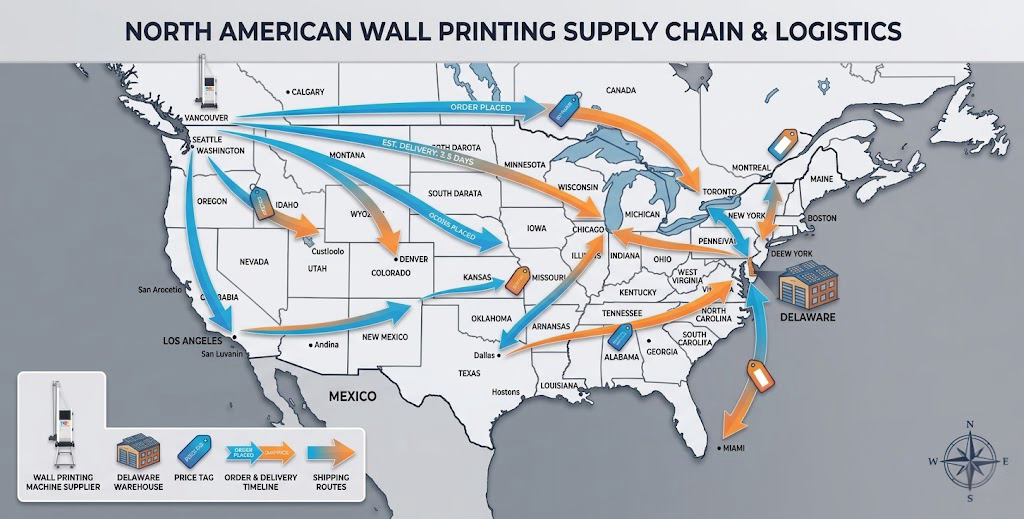
TWP is a U.S.-based distributor and systems integrator, not a manufacturer. They import UV vertical wall printers, bundle proprietary software, training, and support, then ship from their Delaware hub to buyers across North America. For most buyers, that difference is invisible — and that's the point. You're not dealing with a factory in Shenzhen that takes two weeks to reply to a support ticket. You're dealing with a Delaware team that picks up the phone.
What You're Buying
The flagship model is the WP-UV-PRO — their 5th-generation commercial wall printing machine. It prints at up to 2,880 × 720 dpi. Production speed hits around 860 sq ft/hour. That's fast enough for one operator to finish multiple mural jobs in a single day. UV-curable ink bonds to concrete, drywall, plaster, glass, tile, and metal — indoors and out, no primer needed.
Every system ships in a custom hard-shell transport case with precision-cut foam inserts. That's included in the price, not added on later. That detail says a lot about how TWP thinks. Machines that move between job sites take hits. TWP built protection into the package before you had to ask for it.
Pricing and Lead Time
The full turnkey package — machine, training, starter supplies, and support — comes in under USD $35,000. The WP-UV-PRO sits at the upper end of that range. Lead time from the Wilmington warehouse is 2–4 weeks for in-stock models.
The support structure stands out:
Lifetime technical support — no subscription, no expiration date
Reach the team by phone, email, or video call
You're talking to the same people who set up your machine
Spare parts stock in the U.S. — no waiting weeks for overseas shipping
That last point matters more than it sounds. Overseas parts delays are one of the main reasons cheaper machines lose uptime. TWP cuts that problem out entirely.
ROI Reality Check
North American retail pricing for custom mural work runs $15–$35 per square foot. Based on TWP's own data, most buyers recover their full investment within one year. That math holds — as long as you're out selling jobs, not leaving the machine idle.
Who This Is For
TWP's model centers on owner-operators buying single units. There's no volume tier. No dealer pricing. Their focus is small business owners and entrepreneurs adding wall printing as a revenue line — not warehouses ordering ten units at a time.
You want a commercial wall printer with U.S.-based support, a real owner community, and parts you can get without filling out a customs form. TWP is the most complete North American package in this category. The price is higher than direct-from-China options. You're paying for everything that happens after the sale — and that part is where most buyers get burned elsewhere.
How to Order: Submit an inquiry through the "Get More Information" form on their official site. Ask for the full commercial pricing sheet, spare parts cost list, and ink cost per sq ft. Confirm current warranty terms and parts lead times from the Delaware warehouse before you commit.
WallPrintBox.com
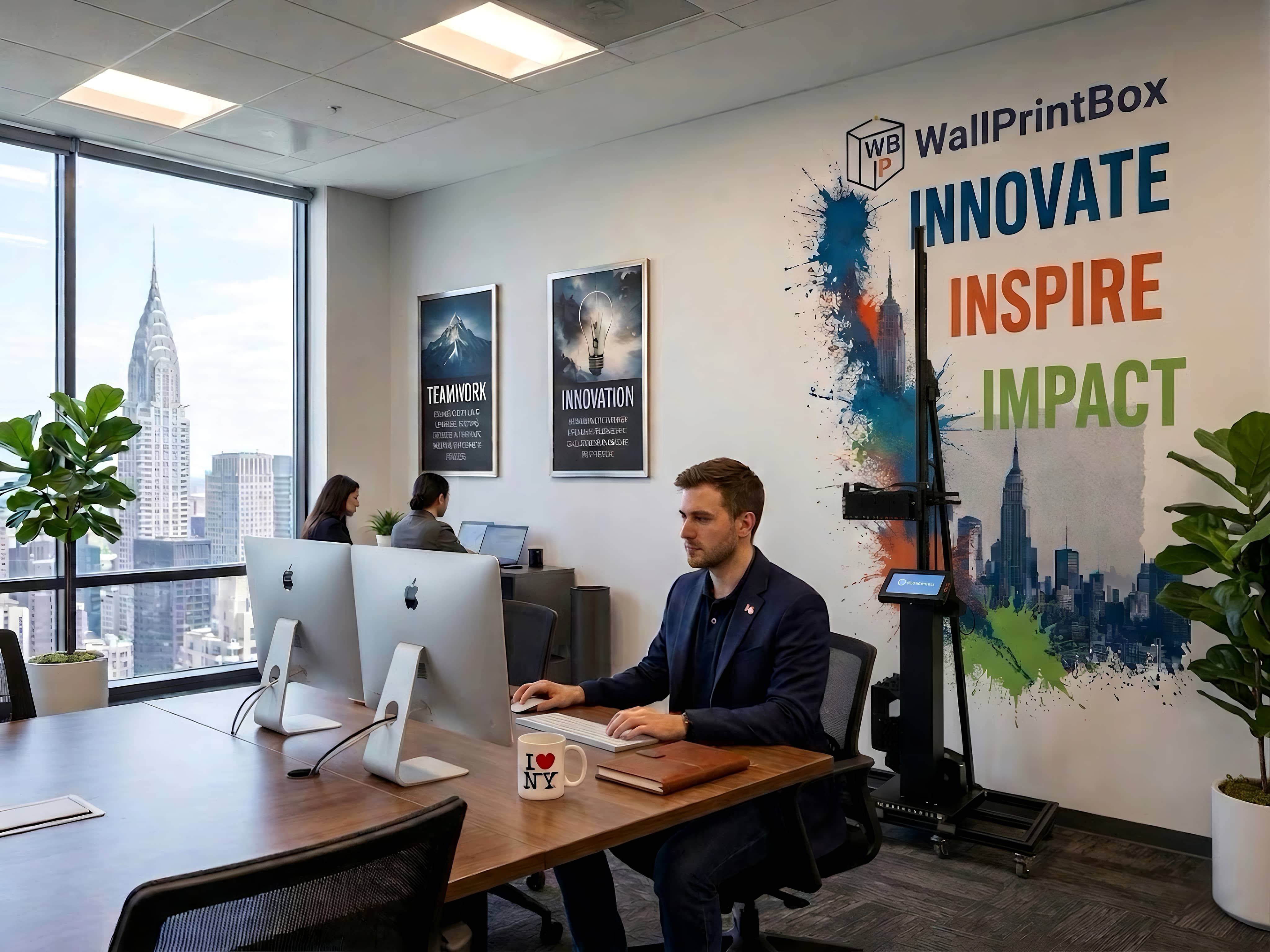
wallprintbox.com | OEM/ODM Manufacturer | Ships to North America
WallPrintBox takes a different approach than most suppliers in this space. TWP built a single-product ecosystem around owner-operators. WallPrintBox, on the other hand, works as an OEM and ODM platform. They sell machines, but they also sell the full infrastructure for businesses that want to build their own brand on top of one.
That difference matters if you're looking at them as a North American buyer.
What They Offer
The main product is an industrial-grade vertical wall printing machine. Some configurations market it as a 3D wall printer, but the effect is UV-textured — not physically raised. Print resolution starts at 360×720 dpi and goes up to 2,880 dpi, depending on the model. You get throughput between 24 m²/hour at mid-quality settings. Both eco-solvent CMYK and UV-curable CMYK+White ink systems are available. That covers everything from interior drywall to glass, ceramic, and metal.
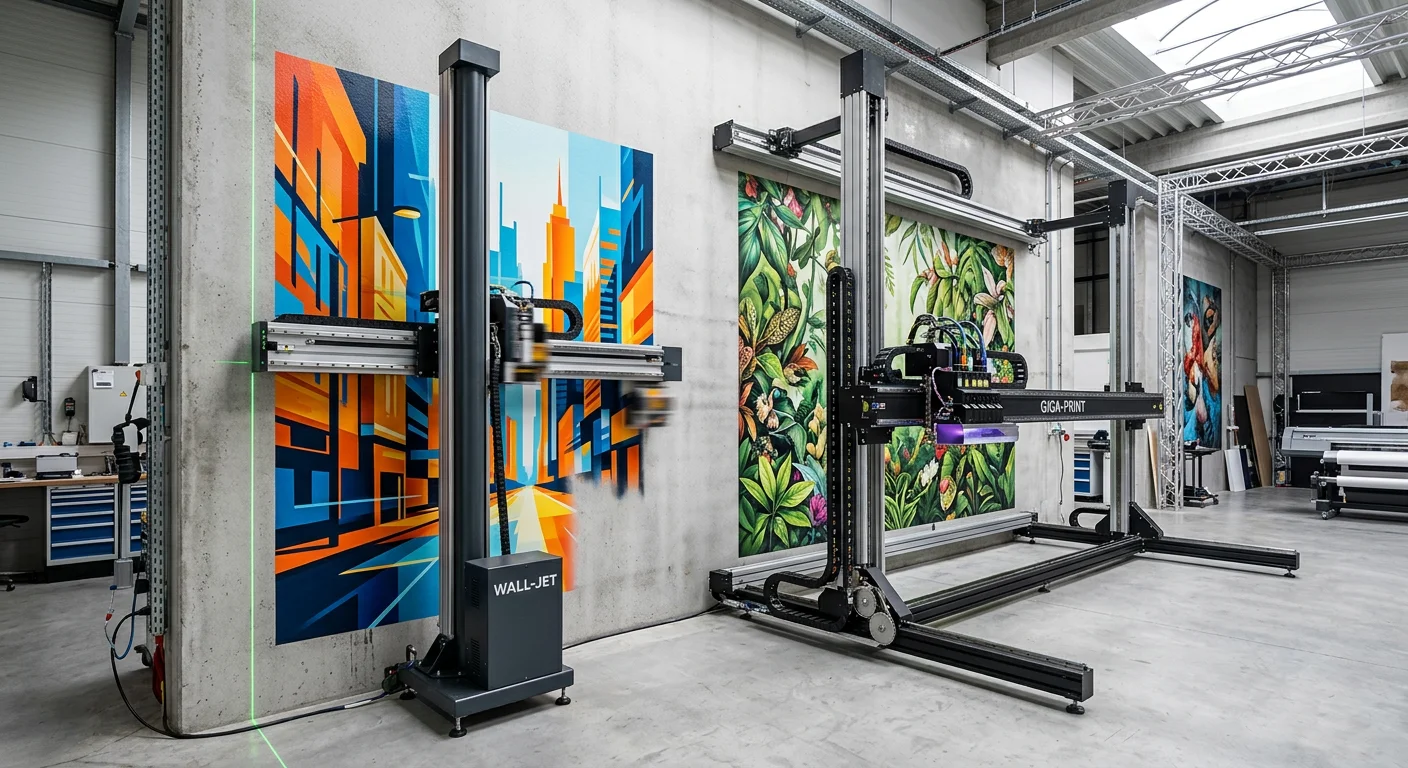
Hardware is flexible. Standard print height runs 2.5 m. Extension modules push that up to 3.5–4.0 m. Rail systems support tiling for unlimited horizontal width. Contractors moving between job sites can choose portable setups with foldable masts and detachable wheels.
Pricing and Lead Time
Configuration | Est. Price Range |
|---|---|
Entry eco-solvent unit (EXW) | $4,000–$8,000 |
UV-capable unit (CMYK+W) | $5,000–$15,000+ |
NA-landed business-in-a-box package | $11,000–$23,000 |
In-stock units from the North American staging warehouse arrive in 3–7 days via LTL freight. Factory-direct or custom OEM builds take longer. Add production and ocean freight time — expect 21–45 days door-to-door.
Support Structure
Parts depots cover both the US East and West Coast. They claim 24–48 hour express delivery on consumables and common components within the continental US. Remote onboarding takes 2–8 hours via video. On-site installation is available for an extra fee. Software licenses are lifetime and tied to hardware serials.
Certifications for North American buyers include FCC compliance, CE marking, and ISO 9001 at the factory level. UV and eco-solvent inks come with full SDS/MSDS documentation. That matters if you run operations in commercial or occupied spaces where indoor air quality is a concern.
Who Routes Through Here
WallPrintBox works with three distinct buyer types. Each has its own intake track:
Solo operators and micro-studios — guided toward single-unit business-in-a-box packages with financing options
Decor contractors and ad agencies — offered fleet configurations (1–3 units) with priority support tiers
OEM buyers and resellers — connected to a dedicated OEM sales channel with MOQ talks starting at 5 units, white-label hardware, and custom firmware options
That segmentation is useful. Your quote reflects your actual use case — not a one-size retail price.
The Trade-Off
WallPrintBox’s advantage lies in its clear OEM/ODM positioning, making it suitable for buyers focused on private labeling, bulk purchasing, distribution, or building localized service capabilities in North America. It not only sells equipment, but also provides supporting solutions such as branding, customization, warehousing, and spare parts support. However, some of its strengths are mainly based on official specifications and service commitments, while public user cases and third-party verification remain relatively limited. Therefore, its actual delivery capability should still be further confirmed, including North American inventory, spare parts supply, after-sales response, SDS/MSDS documents, and contractual service commitments. Before purchasing, buyers are advised to reduce risk through RFQ, sample testing, video inspection, and clear contract terms.
How to Order: Submit the RFQ form on wallprintbox.com. State clearly whether you're a solo operator, a contracting firm, or an OEM buyer. That routing step sets which pricing tier and support package you get quoted. Before signing anything, ask for NA warehouse stock availability, current parts SLA commitments, and ink SDS documents.
WallPen North America
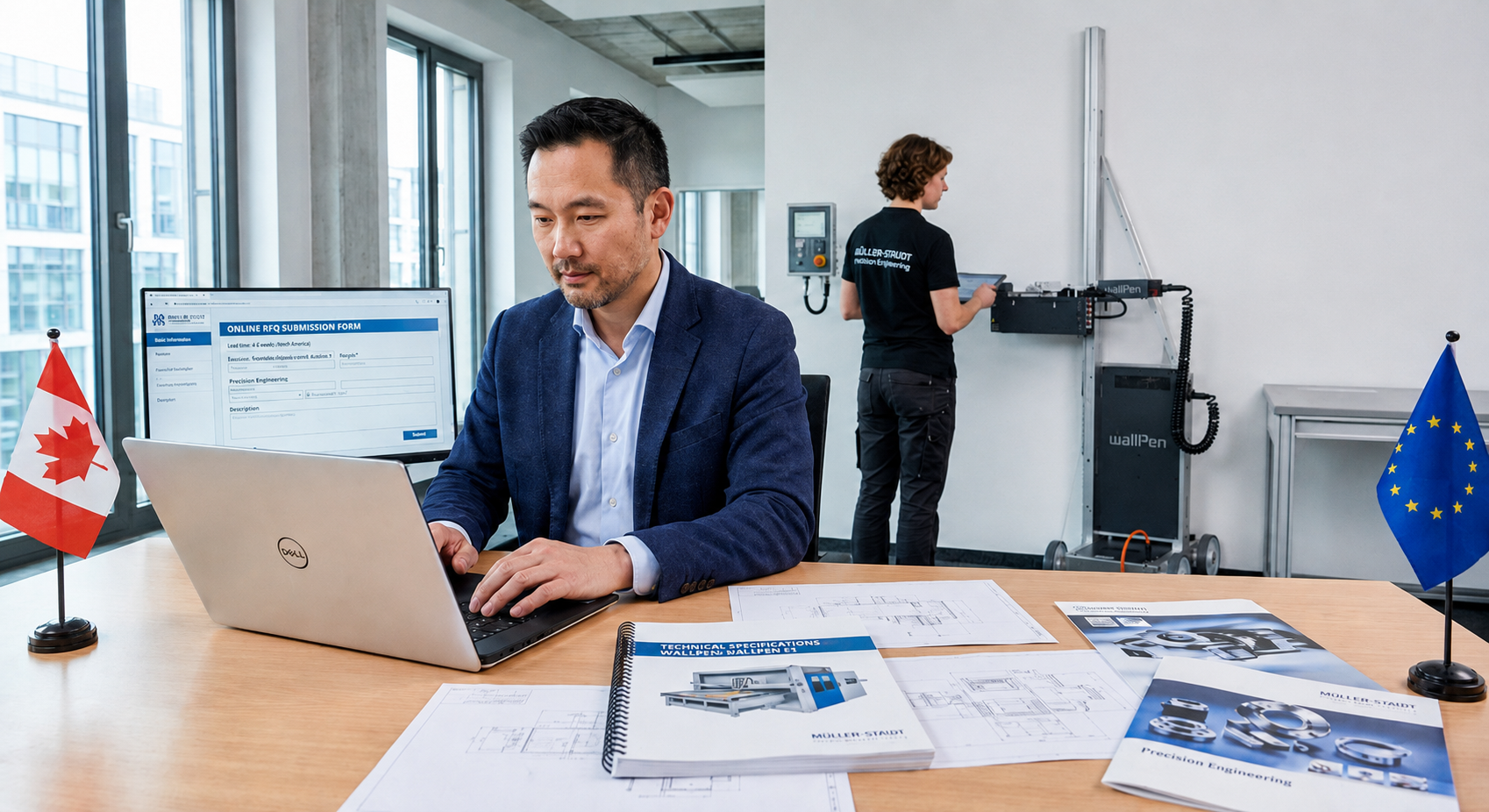
wallpenamerica.com | Made in Germany | North America Dedicated Channel
German engineering doesn't apologize for its price tag. Neither does Wallpen.
WallPen North America is the regional commercial arm of a German-made wall printer platform. It sits at the premium end of the direct-to-wall printing category — not the budget end. The machine is built in Germany. The business model runs on margin, not volume. Price-sensitive buyers will know fast this isn't the right fit.
What You're Paying For
The starting price is $49,630. That figure includes a one-year ink flat rate. That's a real benefit — it keeps your true first-year operating costs clear and predictable. The WallPen system targets professional operators running premium commercial projects. Think high-end hospitality murals, branded environments, and architectural installations. This is a large format wall printing platform built for that level of work.
WallPen doesn't hide its positioning. Their own materials push quality components and reliable supply chains — language straight out of the German industrial equipment playbook. You're not buying a commodity UV wall printer. You're buying into a manufacturing philosophy closer to commercial printing infrastructure than to budget-tier wall inkjet printers pulled from OEM factories.
How the Channel Works
WallPen North America runs through a partner and dealer structure — not a retail storefront. There's a real North America presence, including co-founder story content built for the US market. That matters. You get a regional point of contact. No forwarding emails bouncing to a European headquarters twelve time zones away.
Treat the buying process as a consultative sale. You'll get a configured quote, not a catalog price. Lead times follow European factory builds — confirm the specifics with your dealer contact.
Who This Is For
Simple: buyers who want the commercial wall printer category's strongest premium positioning. You need the capital to back it. And you're selling to clients where "Made in Germany" closes deals.
How to Order: Contact WallPen North America through the official US portal. Ask for a configured quote, ink and consumables terms, delivery window, warranty scope, and full import documentation for North American customs clearance.
wallprinters⁺
wallprinters.com | Support-Led Integrator | Western Market Focus | Est. 2022
Some suppliers sell machines. wallprinters⁺ sells something harder to find — the real-world knowledge of people who've already made the costly mistakes so you don't have to.
wallprinters⁺ launched in 2022. But they didn't start by importing equipment. They started by running a wall printing business — taking real jobs, hitting real problems, figuring out what works on an actual job site. That hands-on history is now the product. Buy a machine through them and you're getting more than hardware. You're getting the hard-won experience of people who've already lived this business, start to finish.
What They Sell
wallprinters⁺ is a curated integrator, not a manufacturer. They match buyers to commercial-grade vertical wall printing machines — UV and 3D-capable. Then they wrap those machines in an operational support layer that most equipment vendors skip entirely.
Print height on the standard setup reaches 175 cm off wheels alone. Add the basic rail package and you're at 325 cm. The extension package takes that to 375 cm. Horizontal width has no real ceiling — rail segments reposition mid-job, so the machine tiles across surfaces of any width.
That matters for commercial mural work. It's also the kind of detail you only pick up from running real jobs, not reading spec sheets.
Pricing and Lead Time
Package Tier | Estimated Range |
|---|---|
Machine + training bundle | ~$30,000–$45,000 |
Lead time (configured + QA) | 3–5 weeks |
For context, TWP runs $25,000–$35,000+. wallPen sits at $45,000–$60,000+. wallprinters⁺ lands between those two. The pricing reflects buyers who want real operational guidance built into the purchase — not added on later as an afterthought.
Support Structure
The support model is content-heavy by design. You get detailed YouTube tutorials, market data guides, and ROI frameworks. These work as both pre-sale and post-sale training material — not filler content. Direct technical and operational support runs through a vendor hotline. Parts ship from OEM component suppliers through a centralized regional distribution point.
Expect high marks for business launch and job execution guidance. The one friction point — shared by most peers in this space — is third-party hardware warranty timelines on imported components.
Hardware sold into North American markets meets FCC conformity standards. Each machine goes through internal QA checks before shipping. That lines up with their "job-tested" positioning.
Who This Is For
wallprinters⁺ is built for entrepreneurs and small operators getting into wall printing who want more than a boxed machine. Your real question probably isn't "what machine do I buy?" It's "how do I build this into a business?" That's the question this channel is set up to answer.
How to Order: Contact wallprinters.com through their primary intake channel. Send a short brief: target industries, average wall dimensions, expected job volume per month, and your location. Ask for a machine + training bundle quote matched to your specs. Also request a proposed training timeline and confirmation of support SLAs — get those details confirmed before you sign.
Vertical Printers
Vertical printers are the backbone of the wall printing industry — and the category most North American buyers are shopping for, whether they know it by that name or not.
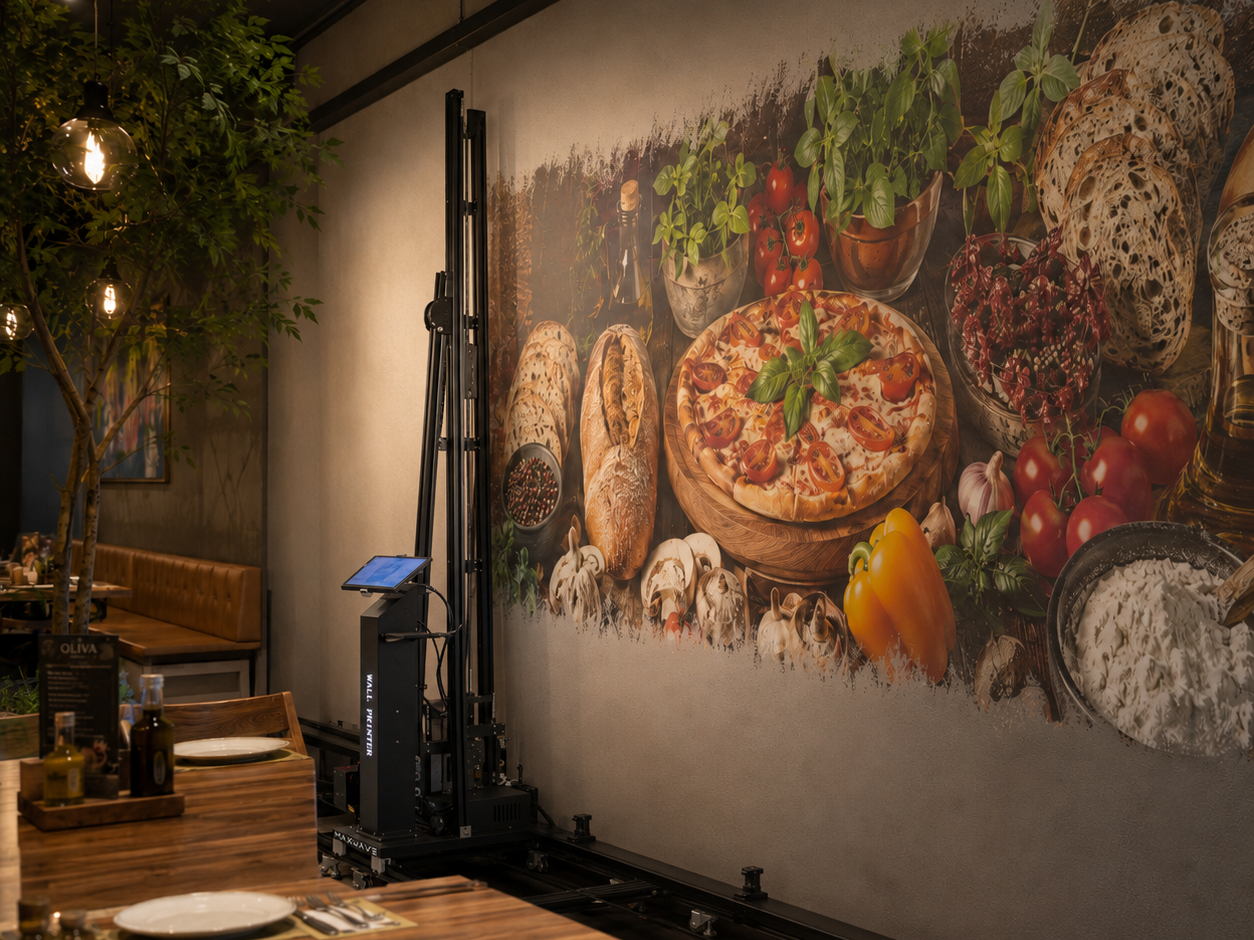
The mechanics are simple. A motorized print carriage moves up and down a vertical rail system placed against the wall. The machine jets UV-curable or eco-solvent ink straight onto the surface. No stencils. No masking. No arm fatigue after hour three of a large mural. Commercial-grade units print up to 2,880 DPI — sharp enough to reproduce photographic detail at full scale.
What separates the options in this category isn't the hardware spec sheet. It's everything wrapped around the machine.
The price bands tell that story:
Market Tier | Typical Range | What You're Buying |
|---|---|---|
Budget / OEM direct | $5,000–$15,000 | Hardware only, support TBD |
Mid-market turnkey (NA-based) | $25,000–$35,000+ | Machine + training + local after-sales |
Premium European (e.g., WallPen) | $45,000–$65,000+ | Brand positioning + build quality |
Most serious North American buyers end up in the mid-market tier. Not because it's cheapest. Fast deployment, usable training, and local support are worth more than cutting $10,000 off the upfront cost. Lose two weeks of billable work waiting on an overseas parts shipment, and that savings disappears fast.
What to Prioritize in This Category
The vertical printer vendors worth your attention bundle four things into the purchase:
Machine matched to your surface types and print height requirements
Onboarding — not a PDF manual, but actual hands-on or live-video training
Workflow software setup configured and ready before the machine ships
Local spare parts access with a defined SLA, not a vague "we'll figure it out"
A vendor that's weak on any of those four points makes the hardware spec almost irrelevant. The machine will sit idle the moment something goes wrong — and something always goes wrong in the first 90 days.
Buyer note: Before closing any vertical printer purchase, ask for a spec sheet tied to the training track included. Machine configurations change across production batches more than most vendors admit. Confirm print height, ink system type, and software version before you sign — not after delivery.
Direct NA-Warehouse Custom Manufacturers (Cross-Border OEM Platforms)
The cheapest path to a custom wall printer in North America runs through a B2B marketplace. That's both its biggest advantage and its biggest risk.
Platforms like Alibaba.com and Made-in-China.com bring together dozens of Chinese OEM factories that store units in U.S. warehouses across California, New Jersey, Texas, and Illinois. No waiting on a 45-day sea freight cycle. The machine is already on this side of the ocean.
Search "vertical wall printer" or "wall inkjet printer" on either platform. Filter by Verified Supplier and Ship from: United States. Then send one direct message to confirm: "Do you have NA warehouse stock right now? City? MOQ?" That's the whole discovery process. Simple as that.
What's in Those Warehouses
NA-stocked units are standard configurations — fixed chassis, one or two Epson XP600 or i3200 print heads, integrated PC, base English UI. Resolution runs 720×1440 dpi up to 2,880 dpi depending on the model. Vertical rail height reaches 2.5–4.0 m with modular extensions. UV-curable and eco-solvent CMYK ink systems are both available.
Custom builds are a different story. Extended chassis, multi-head arrays, dual-column rigs — none of that sits in a warehouse. Those ship from Asia, direct from the factory.
Pricing Reality
Configuration | Est. Price Range |
|---|---|
Mid-range CMYK vertical wall printer (NA warehouse stock) | $18,000–$30,000/unit |
Custom OEM build (5+ units, factory-direct) | $18,000–$30,000 base + 5–15% surcharges |
White-label UI / firmware skinning | +3–8% on base price |
Private-label ink and packaging | +3–10% on base price |
NA warehouse pricing can run slightly higher than EXW China. You're paying for the staging. But you skip ocean freight coordination and customs paperwork. That saves real time and real stress — and both have a cost.
Lead Times
NA warehouse stock: 7–14 days domestic trucking after payment clears. A realistic door-to-installation window is 14–25 days, as long as the unit is already customs-cleared and sitting in a U.S. facility.
Factory custom build + ocean freight: Production alone runs 20–30 days. Add ocean transit and inland delivery, and you're looking at 45–70 days DDP.
Most buyers underestimate this route. Every custom spec adds engineering validation time before production even starts. That time adds up fast.
The Support Gap You Need to Plan For
This is where the numbers shift. Cross-border OEM platforms offer Trade Assurance escrow and a 12-month machine warranty. Print heads often carry just 6 months of coverage — sometimes less, sometimes none at all.
There are no in-house North American technicians. Field support means remote diagnostics over TeamViewer, plus whatever local large-format printer freelancer you can track down yourself.
Spare print heads ship from China or Hong Kong. Air parcel delivery runs 5–10 days. Most experienced buyers stock at least one spare head and key control boards on-site from day one. That's not being overly cautious — it's standard practice for this channel.
The Certification Warning
Most large format wall printing machines from these platforms carry CE, FCC, and ISO 9001 documentation. What they lack is full UL/NRTL listing — the certification that commercial insurance requires for schools, malls, and occupied public spaces.
Running jobs in those environments? Verify certification status before you commit. A machine that saves you $12,000 upfront can create insurance problems that cost far more down the line.
Who This Channel Is For: Experienced importers who know duty rates and HS codes, have local technicians on call, and are buying on price. Comfortable managing the logistics layer yourself? This is the lowest-cost entry into a commercial wall printer operation. Not comfortable with that? The support gap will catch up with you.
Conclusion
The North American wall printer market isn't as barren as it looks from a Google search. Real options exist. Local-warehouse suppliers can put a machine on your floor in under two weeks. Cross-border OEM platforms work for buyers ready to trade speed for margin. Established names like WallPen North America and wallprintbox.com sit somewhere in between.
Here's what matters at the decision point: don't let delivery timelines make the choice for you. Match the channel to your cash flow. Think about your technical confidence. Consider how fast you need revenue coming in.
Launching a commercial wall printer business in the next 90 days? Put local inventory and post-sale support ahead of sticker price. A $1,200 savings means nothing when your machine is down and nobody picks up the phone.
Pick your channel. Request a demo unit or spec sheet. Then move.
The walls are waiting.