Finding a reliable wall printer manufacturer in 2026 is more than a purchase — it's a decision that shapes your business.
Dozens of brands are flooding the market right now. Telling apart true direct-to-wall printing innovators from repackaged hardware sellers with empty after-sales support has become genuinely difficult.
This guide cuts through that noise.
We built a 6-dimension evaluation framework to rank and score the top ten manufacturers worth your attention this year. It covers:
Technical capability
Product range
Global service networks
Pricing
Customer reputation
Innovation
Bulk importer negotiating MOQs? First-time buyer calculating ROI on a large format wall printer? Industry researcher mapping the competitive landscape? This guide gives you a sharper decision — and helps protect your investment.
WallPen
$49,630. That's the starting price for a wallPen unit. It tells you exactly where this manufacturer stands in the market.
wallPen GmbH is based in Wissen, Germany — and they own it proudly. Their identity centers on one bold claim: the original wall printer, made in Germany. If you've spent time sorting through cheap Asian imports, that phrase means something real.
What You're Buying
The wallPen system is a complete mobile vertical wall printer. You get a frame, UV inkjet printhead, ink delivery system, control software, and operator training — all bundled as a professional business deployment kit. The entry price also covers a one-year ink flat rate, which helps soften the upfront cost for year-one operations.
Print modes include CMYK, white-only, CMYK+W, and W+CMYK sequences. That makes it one of the few systems capable of reverse printing on glass and plexiglass. This is a real edge for interior branding projects — hotels, corporate offices, retail spaces.
Speed is a genuine strength here. Real-world demos show a 3×3 ft image at 8-pass finishing in 33 minutes. Comparable mid-tier machines take 75+ minutes for the same job. That's not a marketing claim. That's real throughput you can plan a production schedule around.
The wallPen iOS/Android app handles everything: image scaling, color mode selection, and head-distance limits. The workflow is clean and built for professional use.
Who It's Right For
This machine suits firms with solid capital budgets and steady client volume. Think interior decoration companies, hotel muralists, and sign shops adding on-site printing to existing UV workflows.
Not the right fit for budget-first startups or low-frequency operators. At this price, idle equipment costs you money fast.
Honest Drawbacks
Calibration is non-negotiable. You need trained operators to maintain the ~0.3-inch head-to-wall standoff distance. This is not a plug-and-print machine.
Ongoing ink and service costs reflect German industrial-grade parts. Running costs stay high well past year one — plan for that from the start.
Regional support runs through partners like SurfacePix in North America. Response quality depends on your local dealer. Verify that relationship before you commit.
Starting Price | $49,630 (incl. 1-yr ink flat rate) |
Print Technology | UV Inkjet — CMYK + White |
Production Speed | ~2 m²/h (high-quality multipass) |
Surfaces Supported | Plaster, concrete, paint, glass, plexiglass |
Best For | Professional decoration firms, interior branding |
wallprintbox
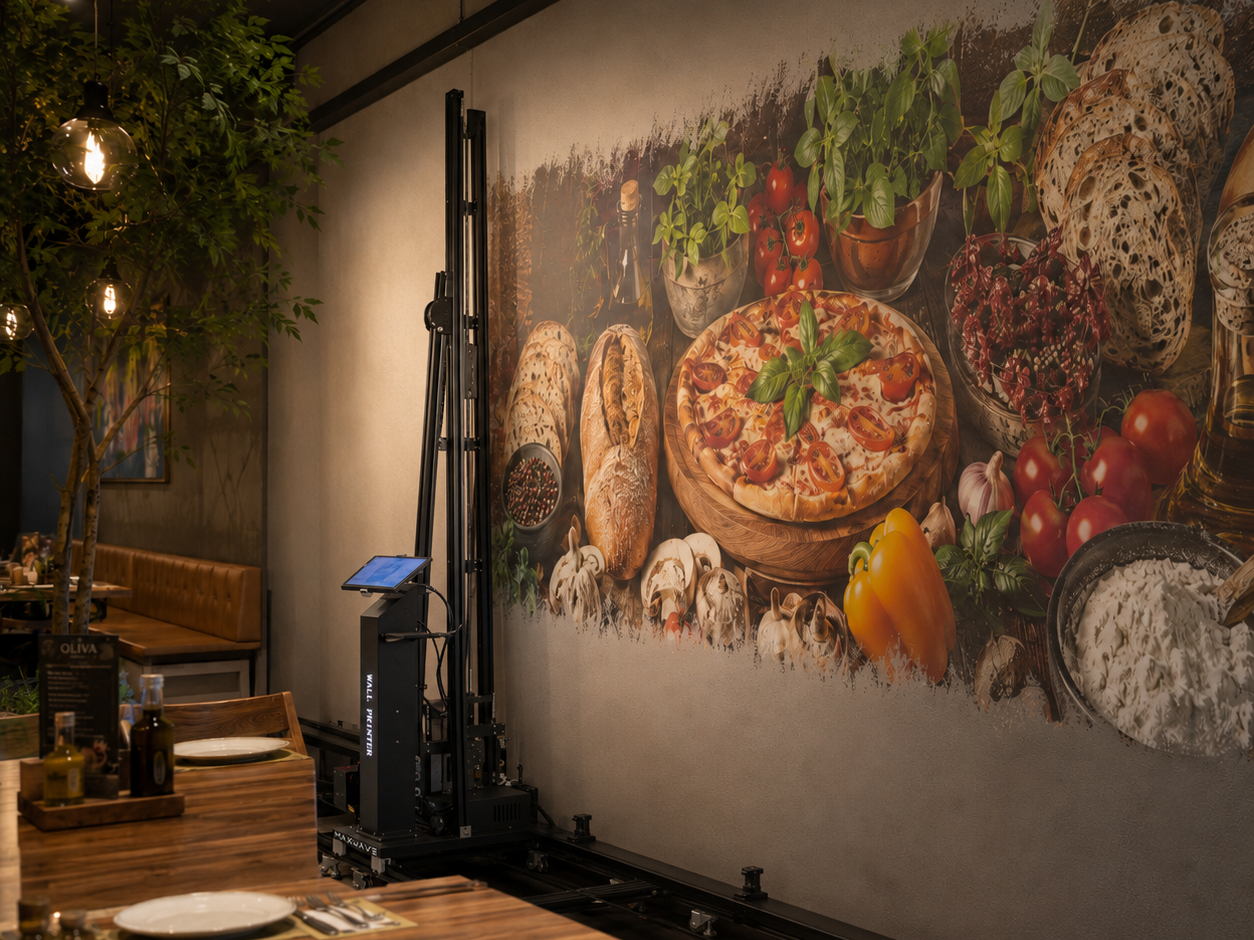
The pitch here is different from anything else on this list — and that's the point.
wallprintbox isn't selling you a machine. It's selling you a business. The whole product is built around one idea: take a first-time operator from unboxing to a paid client job in under 14 days. That's a bold claim. But based on how the kit is put together, it's not an unreasonable one.
This model fits a specific type of buyer. Think someone stepping into the wall decoration market with no existing print operation behind them. Solo entrepreneurs, small sign shops moving into large format wall murals, overseas distributors wanting to white-label hardware under their own brand. wallprintbox.com targets all three.
What the Kit Includes
The core offering is a "Business-in-a-Box" ecosystem. Hardware is just one layer.
The GP200L Pro Series delivers vibrant 5-color wall printing for everyday commercial and decorative projects. For those looking to create premium, high-value murals, the GP200X Flagship's 7-color system unlocks richer colors, smoother transitions, and eye-catching textured effects that elevate walls from graphics to artwork.
Key specs across the lineup:
GP200I Starter | GP200L Pro | GP200X Flagship | |
|---|---|---|---|
Print Technology | Piezoelectric UV Inkjet | Piezoelectric UV Inkjet | Piezoelectric UV Inkjet |
Print Head | Single Epson I1600U | Dual Epson I1600U | Dual Epson I3200U |
Resolution | 740 × 2880 DPI | 740 × 2880 DPI | 740 × 2880 DPI |
Max Print Height | 3.5 m seamless | 3.5 m seamless | 3.5 m seamless |
Speed | 6~8 m²/hr | 10~12 m²/hr | 12~24 m²/hr |
Ink System | UV / Eco-solvent CMYK+W | UV / Eco-solvent CMYK+W | UV / Eco-solvent CMYK+W+LC+LM |
FOB Price Range | ~$5,500–$11,000 | ~$6,600–$13,000 | ~$6,300–$15,000 |
The standard kit ships as one complete package. You get a RIP software license, starter ink, calibration tools, a spare parts pack, remote onboarding sessions, an ROI calculator, and ready-made marketing collateral. No hunting down consumables on your own. No guessing at pricing strategy. The playbook comes with it.
The ROI Tools Are Worth Using
Most manufacturers hand you a machine and leave you to figure it out. wallprintbox.com takes a different approach. You get a web-based ROI calculator that runs on local inputs — labor rates, ink cost per m², travel overhead, depreciation schedule. It spits out a payback period in months and a break-even volume figure. For a first-time buyer doing pre-purchase research, that's a practical tool. It shifts the question from "can I afford this machine" to "here's the month this machine pays for itself."
The Distributor Path Is Well-Defined
OEM-ODM buyers ordering 5–10 units per batch get custom color schemes, localized UI, translated training materials, and co-branded marketing support. Compliance documentation covers CE and RoHS. Optional FCC and UKCA are available depending on your destination market. This is a structured distribution program — built with intent, not tacked on as an afterthought.
Where It Falls Short
The all-in-one framing won't suit every buyer. Technical operators who want bare hardware will find the bundled content — pricing scripts, sales playbooks, social media templates — more noise than help. So if you already have your workflow locked in, you're paying for tools you won't use. Also, optional add-ons like advanced color-management tools and extra print heads can push your total spend well above the base kit price. Factor that in before you commit.
Scores (6-Dimension Evaluation)
Dimension | Score |
|---|---|
Technical Capability | 8.5 / 10 |
Product Range | 9.0 / 10 |
Global Service Network | 9.5 / 10 |
Price Competitiveness | 9.0 / 10 |
Customer Reputation | 8.5 / 10 |
Innovation Capacity | 9.0 / 10 |
Best For: First-time entrepreneurs, sign shops expanding into wall art printing, and overseas distributors who want a white-label direct-to-wall printing solution with business tools built in.
Not Ideal For: Buyers who want stripped-down hardware at the lowest entry cost, or experienced operators with existing workflows who have no use for the bundled ecosystem.
TWP – The Wall Printer
North America has its own answer to wall printing — and TWP has spent years building a real community around it.
The Wall Printer (TWP) found its own space in the market. It's not the cheapest machine out there. It's not the most advanced either. But it's the most supported starting point for US and Canadian operators who want to launch a wall printing business without starting from zero.
The founder puts the full investment at under $35,000. That covers hardware, training, supplies, and ongoing support. That number is honest. No stripped-down base price. No hidden add-ons waiting around the corner.
The Product Lineup
TWP runs three primary lines:
Model | Surface | Speed | Price |
|---|---|---|---|
T Series Wall Printer | Vertical walls | ~1.5–3 m²/h | $25,000–$35,000+ |
FUV Floor Series | Horizontal floors | ~1.5–3 m²/h | From $39,995 |
WP-UV-Pro | Vertical walls | Up to 3 m²/h | From $44,995 |
All units run UV-curable ink through genuine Epson printheads, printing up to 1440 DPI. Ink cost stays under $0.50/sq ft. Most operators charge $20–$40/sq ft to end clients. The margin math works.
What Sets TWP Apart
The machine is solid. But the machine isn't really the product.
The real offer is the 300+ owner community, plus business coaching, CRM access, pricing guides, social media templates, and operator training. All of that comes bundled — no franchise royalties attached. You set your own prices. TWP stays out of it.
Parts and ink ship from North American stock. Critical components reach you in 24–72 hours. That's a big deal compared to the two-to-six weeks you'd wait with Asian-sourced alternatives.
Where It Falls Short
TWP isn't built for global OEM buyers who want custom hardware setups or white-label options. Asian manufacturers handle that side of things with more flexibility. Also, at $25,000–$45,000+, the price gap versus Chinese brands in the $5,000–$15,000 range is real and worth acknowledging.
Portability is another clear limitation. TWP's commercial chassis doesn't suit tight corridors or frequent vehicle loading. That's just the trade-off for a machine built around commercial-grade performance.
Scores (6-Dimension Evaluation)
Dimension | Score |
|---|---|
Technical Capability | 7.5 / 10 |
Product Range | 7.5 / 10 |
Global Service Network | 7.0 / 10 |
Price Competitiveness | 7.0 / 10 |
Customer Reputation | 8.5 / 10 |
Innovation Capacity | 7.0 / 10 |
Best For: US and Canadian entrepreneurs starting a wall printing business from scratch. Also great for existing sign shops adding vertical printing, and hospitality contractors who need local parts, local training, and a proven business playbook.
Not Ideal For: International OEM buyers, budget-first operators, or anyone who needs compact portable equipment for tight job sites.
Dxonjet
Chinese industrial hardware gets dismissed too fast. DXonJet deserves a real look.
The company is based in China and ships to Europe and North America. DXonJet makes UV vertical wall and floor printers built for entrepreneurs who want commercial-grade output without European price tags. The flagship VPJet 4.0 uses an Epson i3200 U1 HD printhead at 1200 DPI, 8-pass. In a documented 10.8 m² mural test, it held a steady 2.7 m²/hr. That's real throughput — not a spec sheet claim.
What Works
The ink system is well-built for its price class. You get automatic flow control, scheduled head-cleaning, and an ink consumption monitor — all standard. A 2024 software update improved UV lamp timing and boosted print stability. Small refinements, yes. But they signal a team that's still working on the product, not walking away from it.
Surface compatibility covers a wide range: walls, glass, metal, and wood. Pricing for i3200-class machines like this sits between $9,000–$15,000. That gap is hard to ignore compared to German or American alternatives.
Where It Falls Short
At 2.7 m²/hr, one large mural can eat up your whole day. Multi-head systems solve that bottleneck — DXonJet doesn't offer one yet. The software side is still catching up. Outside Poland and the US download portal, support leans on remote assistance and local third-party technicians. That works for some buyers. For others, it's a risk worth thinking through.
Dimension | Score |
|---|---|
Technical Capability | 7.0 / 10 |
Product Range | 6.5 / 10 |
Global Service Network | 7.0 / 10 |
Price Competitiveness | 8.5 / 10 |
Customer Reputation | 7.5 / 10 |
Innovation Capacity | 6.5 / 10 |
Best For: SMEs and solo operators stepping into the wall mural market. Tight budget, but quality is non-negotiable.
Not Ideal For: High-volume contractors running multiple large-format jobs each day, or buyers in regions without solid local support coverage.
Friankor
Friankor holds an interesting spot in the 2026 wall printer market. It doesn't win on the lowest price. It doesn't out-spec German machines either. What it does is solve a problem most manufacturers skip over: a solo operator needs to print walls and floors, from a van, alone, in a shopping mall lobby by 9am. That's the real challenge Friankor built a machine around.
Two Machines. One Frame.
The product line breaks into two clear tiers.
The wall-only model (MK01) handles vertical murals — retail walls, office interiors, outdoor façades. It runs industrial Ricoh G6 or Epson I1600 printheads with UV-curable CMYK ink. Speed sits at 1.2 m²/hr in high-resolution mode. Complex gradients, fine text, photo-quality imagery — the motion control handles all of it without visible banding, as long as you calibrate it right. FOB pricing lands at $9,000–$15,000, which is solid value for this printhead class.
The dual-surface model (MK02) is the more interesting machine. It uses the same print engine but with a reconfigurable frame. You switch between vertical wall mode and horizontal floor mode on-site. That unlocks a different revenue stream: 3D floor graphics, exhibition showrooms, hotel lobbies, theme parks. The added engineering comes at a price — $30,000–$45,000 depending on configuration.
MK01 (Wall) | MK02 (Wall + Floor) | |
|---|---|---|
Max Speed | ~1.2 m²/hr | ~1.0–1.2 m²/hr |
Printheads | Ricoh G6 / Epson I1600 | Same, multi-head optional |
Ink System | UV-curable CMYK | UV CMYK + optional varnish |
Segment Weight | <70 kg per module | Heavier; still modular |
FOB Price | $9,000–$15,000 | $30,000–$45,000 |
Built for Field Operators
The modular rail system breaks into sub-assemblies, each under 70 kg. One person, a trolley, and 10–15 minutes — that's all it takes to go from unloading to ready-to-print. For operators running multiple site visits per day and billing by the square meter, that kind of setup speed makes a real difference.
Friankor also runs a structured distributor program. Regional partners handle local training, installation, and warranty support. The ROI case they pitch is bold. For new market entrants, having that technical support layer behind you is a genuine advantage.
Where to Be Careful
Switching between wall and floor mode means doing a full Z-height recalibration. Skip it and you risk banding or a head strike. The process itself isn't hard, but it takes discipline — more so under job-site time pressure.
Spare parts are the other thing to check before you sign. Parts access outside major distributor regions can vary. Ask your local partner direct questions about printhead lead times and board replacement availability. Don't take it for granted.
Scores (6-Dimension Evaluation)
Dimension | Score |
|---|---|
Technical Capability | 7.5 / 10 |
Product Range | 8.0 / 10 |
Global Service Network | 7.0 / 10 |
Price Competitiveness | 8.0 / 10 |
Customer Reputation | 8.0 / 10 |
Innovation Capacity | 8.5 / 10 |
Best For:
- Solo mural contractors who need portable, fast-deploying equipment
- Floor graphics specialists
- Distributors entering new regional markets with a manufacturer-backed support program
Not Ideal For:
- High-volume wall-only operations — the MK02's dual-surface price premium adds cost without adding value in that use case
- Buyers in regions without confirmed distributor coverage
Tanyu Wall Printer
Suzhou Tanyu Technology Co., Ltd. has been building wall printers since 2012 — long before the market got crowded.
Starting that early means something. Engineering decisions come from real experience, not guesswork. The product line has gone through 10+ years of changes, shaped by feedback from real buyers and real operators.
What Tanyu Sells
Three models carry the lineup:
TPP1000 — UV wall printer, built for indoor murals
TMP1000 — the main wall-printer model, most often quoted by buyers
TWF1000 — prints on both walls and floors, UV ink, priced at $9,800–$12,000 per set
Print speed runs 2–6 m²/hr, depending on mode and resolution. The machine is compact: 700 × 300 × 2,600 mm. MOQ is one unit. That matters — you don't need to buy in bulk just to get started.
Training is included: manuals, video tutorials, and live remote sessions. The warranty runs 12 months. You also get lifelong technical support via IM and video calls.
Who This Machine Is For
Tanyu doesn't compete with wallPen or TWP on output volume. It's not built for that. The target buyer is a first-timer — someone starting a wall decoration business, running a school workshop, or testing demand before putting serious money in.
At this price point, the entry cost is low. A failed test doesn't hurt you badly.
One thing to check: consumable costs and printhead replacement prices aren't always clear in standard product listings. Get a full cost breakdown in writing before you commit.
Scores (6-Dimension Evaluation)
Dimension | Score |
|---|---|
Technical Capability | 6.5 / 10 |
Product Range | 7.0 / 10 |
Global Service Network | 6.5 / 10 |
Price Competitiveness | 9.0 / 10 |
Customer Reputation | 7.0 / 10 |
Innovation Capacity | 6.5 / 10 |
Best For: First-time buyers, micro-businesses, schools, and small interior decoration projects where keeping financial risk low is the priority.
Not Ideal For: High-volume commercial studios running continuous production loads.
Shenyang Faith Technology
Fifteen years of exporting industrial inkjet equipment to Europe. That kind of track record speaks for itself. Shenyang Faith Technology has built exactly that.
Faith is based in Liaoning province. The company started as a coding and traceability specialist — CIJ printers, TIJ coders, and laser markers for packaging lines. The 3D wall printer came later. It grew naturally from that UV inkjet background. This wasn't a sudden shift into new territory. That matters when you're sizing up supplier risk.
Their 3D UV wall printer uses piezoelectric printheads at up to 720×1440 DPI. UV-curable ink builds tactile texture across multiple passes. Print speed runs 1.0–1.3 m²/hr in high-resolution 3D mode. FOB pricing sits between $10,000–$18,000 for textured configurations. That's competitive for this output class.
The real advantage here isn't the machine. It's the paper trail.
Fourteen years active on Alibaba
Listed on Made-in-China and TradeWheel
Documented export history to Spain and the UK
You're doing due diligence on an overseas supplier. That kind of verified, long-standing export record gives you something solid to stand on.
A few limitations worth knowing:
Software polish depends on remote support, not an in-house team
On-site service goes through local agents — no overseas branches
3D texture consistency ties closely to operator skill level
Scores (6-Dimension Evaluation)
Dimension | Score |
|---|---|
Technical Capability | 7.0 / 10 |
Product Range | 7.5 / 10 |
Global Service Network | 7.5 / 10 |
Price Competitiveness | 8.0 / 10 |
Customer Reputation | 7.5 / 10 |
Innovation Capacity | 7.0 / 10 |
Best For: Importers who want one Chinese supplier covering both industrial coding equipment and 3D wall printing. You also get 15 years of export documentation to back it up.
Not Ideal For: Buyers who need hands-on local service or ready-to-use software straight out of the box.
HKHR Wall Printer
HKHR started in 2009. Since then, they've built an installed base of over 2,000 T-Series units worldwide. That number speaks louder than any marketing claim.
The company is based in Nanjing and covers a wide range of decorative and advertising uses — interior murals, hotel lobbies, retail branding walls, and parking lot floor graphics. Their lineup starts with the portable HK-W1, a CMYK+White UV unit built for on-site contractors. It goes up to the more capable ZK-Q8 and the broader T-Series LED UV range.
Resolution reaches 1440 DPI across distributor spec sheets. The built-in controller runs Windows 10 on an Intel Celeron J1800. You get a 10.4-inch touchscreen and 128 GB SSD. Solid and practical — nothing extra. Ink options vary by model: some run UV-curable, others use water-based. Real-world output lands at 1–3 m²/hr at quality print settings.
Pricing through regional distributors falls in the $8,500–$22,000 range. That's fair value for what you're getting.
The software runs a standard HP-RTL raster workflow. It works fine, but don't expect advanced nesting or tiling automation built in. For buyers seeking a proven large format wall printer with an established global install base, HKHR remains a manufacturer worth considering.
Scores (6-Dimension Evaluation)
Dimension | Score |
|---|---|
Technical Capability | 7.0 / 10 |
Product Range | 7.5 / 10 |
Global Service Network | 6.5 / 10 |
Price Competitiveness | 8.5 / 10 |
Customer Reputation | 7.0 / 10 |
Innovation Capacity | 6.5 / 10 |
Best For: Sign shops and interior contractors stepping into wall printing at a mid-range budget. Works best with a confirmed local distributor already in place.
Not Ideal For: Buyers in areas with limited distributor coverage. Also not the right fit for operators who need advanced RIP workflows ready to go from day one.
Langfang Mycoo Intelligent Equipment
Langfang, Hebei has grown into one of China's more active industrial equipment export corridors. Mycoo is one of the names coming out of that region.
The honest problem: verified public data on Mycoo is thin. Model names, certified specs, and independent customer reviews don't show up in the import-export records you'd use to stress-test a supplier. That's not a dealbreaker on its own. Plenty of legitimate mid-tier Chinese wall prinrer manufacturers sit below the data radar. But it does mean your due diligence has to work harder here.
The export data does confirm a regional pattern worth noting. Langfang-based intelligent equipment firms have documented shipment records across India, the Philippines, and Ecuador. That's a real footprint — not a paper company.
Nail down these three things in writing before engaging Mycoo:
- Printhead brand and model (Epson or Ricoh — get the part number)
- Ink type and regional consumables availability
- On-site service coverage in your market
Scores (6-Dimension Evaluation)
Dimension | Score |
|---|---|
Technical Capability | 6.0 / 10 |
Product Range | 6.0 / 10 |
Global Service Network | 5.5 / 10 |
Price Competitiveness | 7.5 / 10 |
Customer Reputation | 5.5 / 10 |
Innovation Capacity | 6.0 / 10 |
Best For: Budget-focused buyers already working in markets where Langfang exporters have active trade routes. You'll need the technical know-how to verify supplier claims on your own.
Not Ideal For: First-time buyers who need a verified, documentation-backed supplier from day one.
Shenzhen Handtop Group
Registered capital of 72,000,000 CNY. A 10-year average R&D tenure. Ties to Hanglory Group. These aren't the numbers of a small startup.
Shenzhen HandTop Tech Co., Ltd. builds large-format UV digital printing systems in Shenzhen, Guangdong. They run facilities across Bao'an and Longgang District. Their scope covers hardware, software, mechanical design, ink formulation, and application support. That's full vertical integration — not reselling.
The main product lineup runs on UV flatbed and hybrid platforms: the HT2512UV, HT2500UV, and HT3200 hybrid series. Their core markets are signage and industrial print jobs. That's not the decorative mural space where most wall printer buyers are looking.
That's the real gap here. Handtop's strengths are in industrial print systems. Direct-to-wall decoration sits nearby — but it's a different category.
Your project needs large-format UV flatbed capability with solid manufacturing infrastructure behind it? Handtop is worth a conversation. You need a field-ready wall mural machine with solid after-sales coverage? Check other options on this list first.
Dimension | Score |
|---|---|
Technical Capability | 7.5 / 10 |
Product Range | 6.5 / 10 |
Global Service Network | 6.0 / 10 |
Price Competitiveness | 7.5 / 10 |
Customer Reputation | 6.5 / 10 |
Innovation Capacity | 7.0 / 10 |
Best For: Industrial signage makers and system integrators who need large-format UV platforms with strong R&D depth behind them.
Not Ideal For: Buyers focused on portable wall art printing gear or field-deployment mural solutions.
Conclusion
The wall printing industry in 2026 has no shortage of options — just a shortage of clarity. These ten manufacturers were evaluated across six key dimensions. One truth stands out: the right machine isn't the most expensive one. It's the one built for your business model, your markets, and your margin targets.
Building a regional distribution network as a B2B importer? Or putting your first capital into a large format wall printer as an entrepreneur? Either way, the gap between a smart purchase and a costly mistake comes down to due diligence. Do it before the wire transfer clears.
Start here:
Request factory audit reports.
Demand live print demonstrations on your target substrate.
Call their existing customers — not the references they hand you.
The manufacturers on this list are the strongest in the industry right now. Your job is to shortlist three. Pressure-test them hard. Then pick the one that answers the phone at 2am when something goes wrong.
That's the manufacturer worth building a business around.
Still comparing suppliers? Contact the WallPrintBox team for a live machine demonstration, factory information, and expert advice on choosing the right wall printer for your market and business goals.