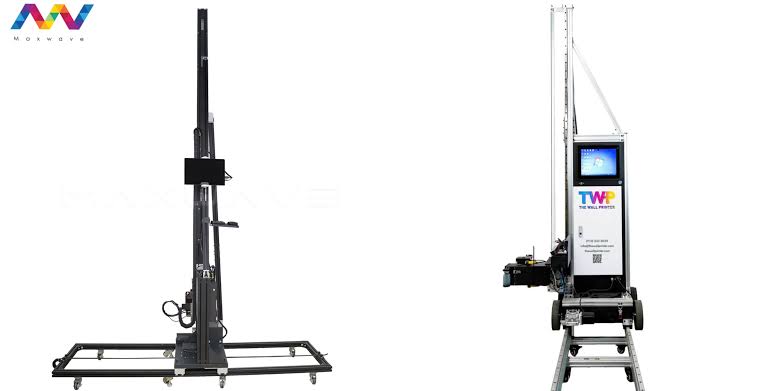
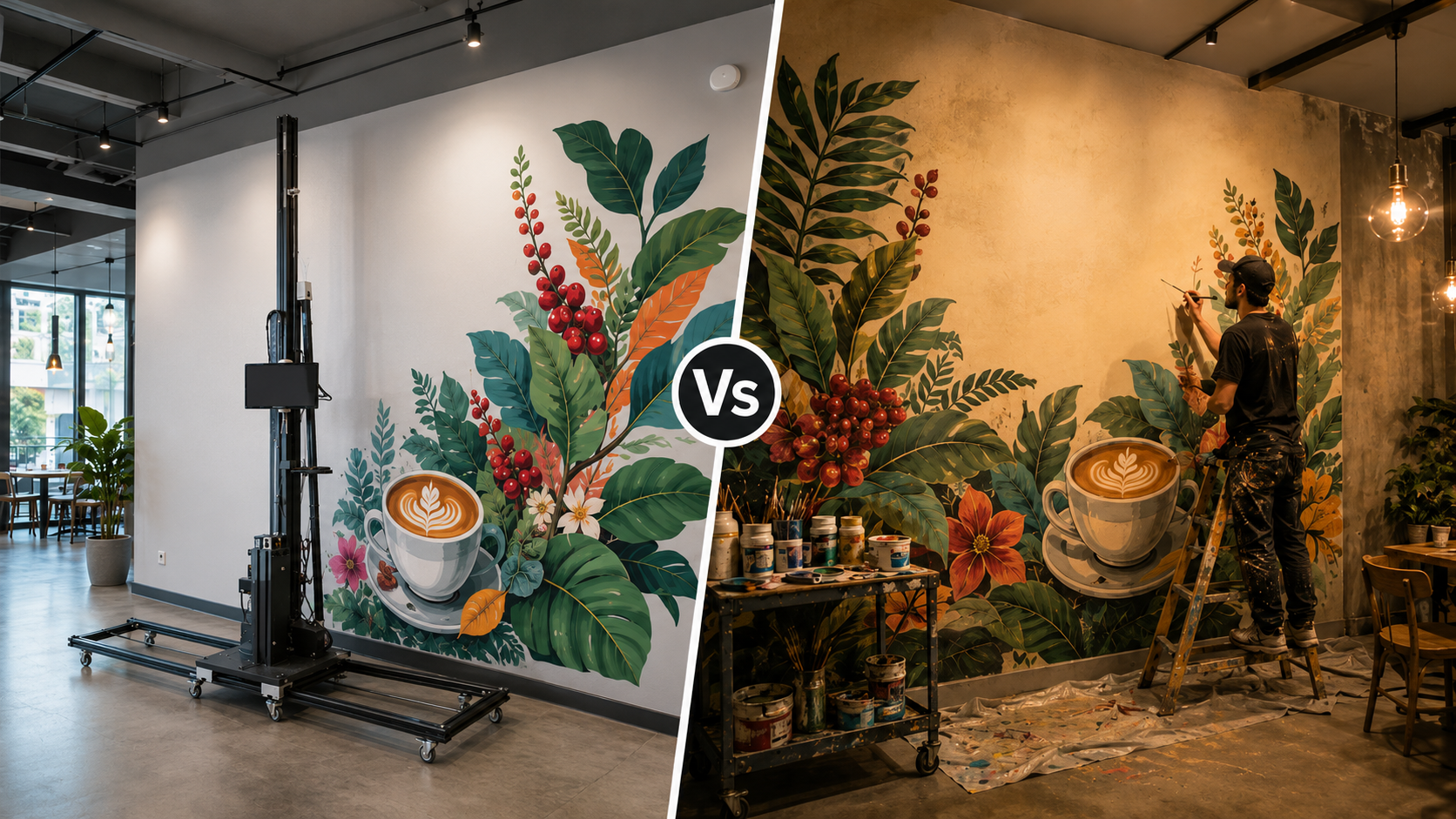
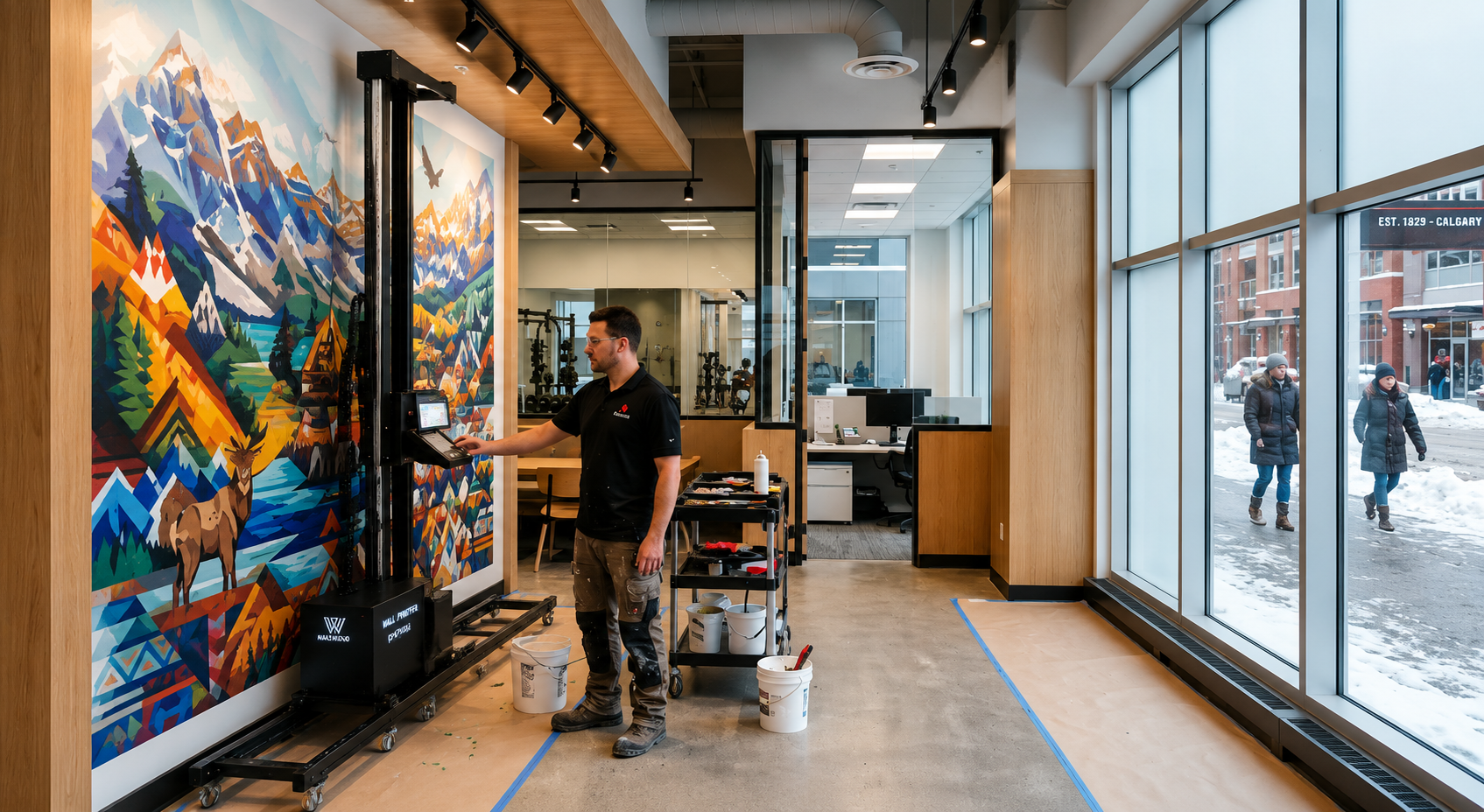
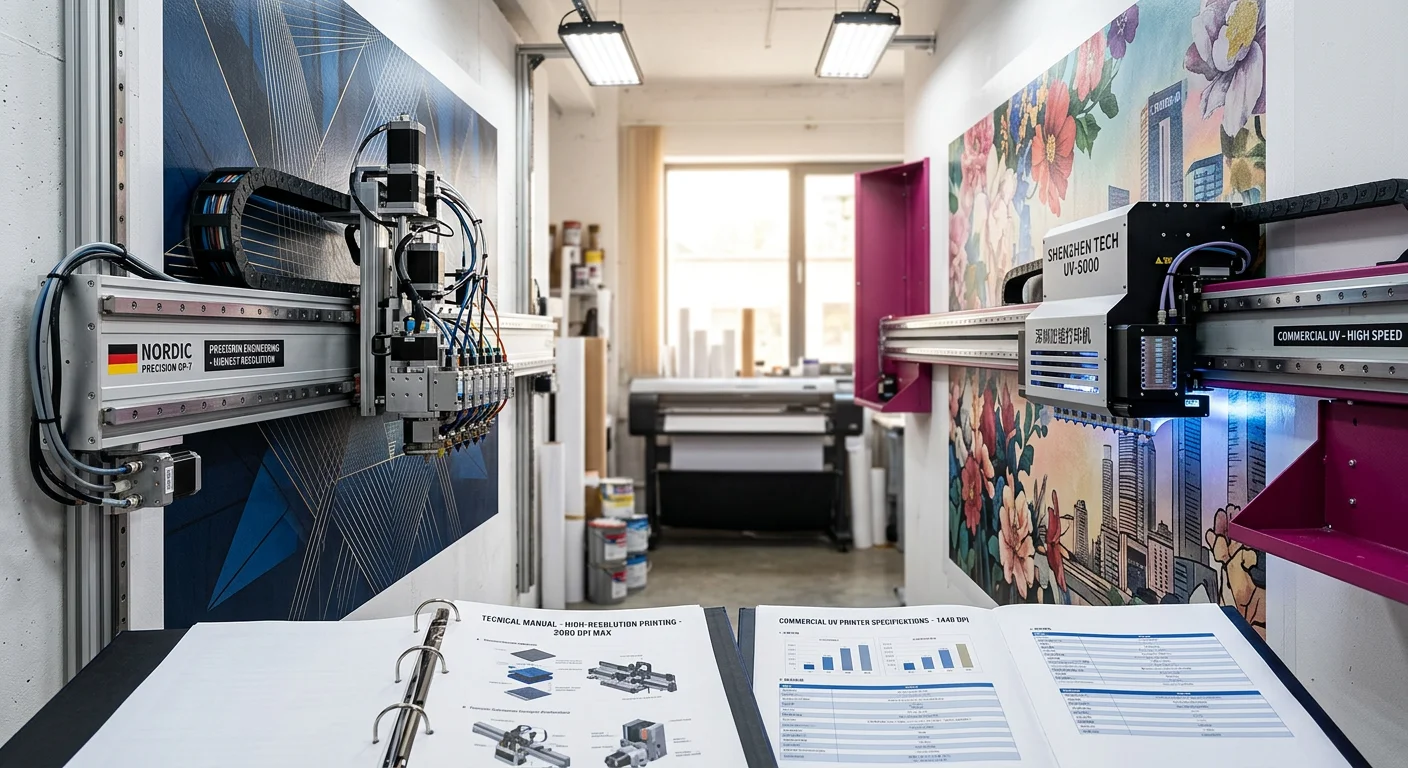
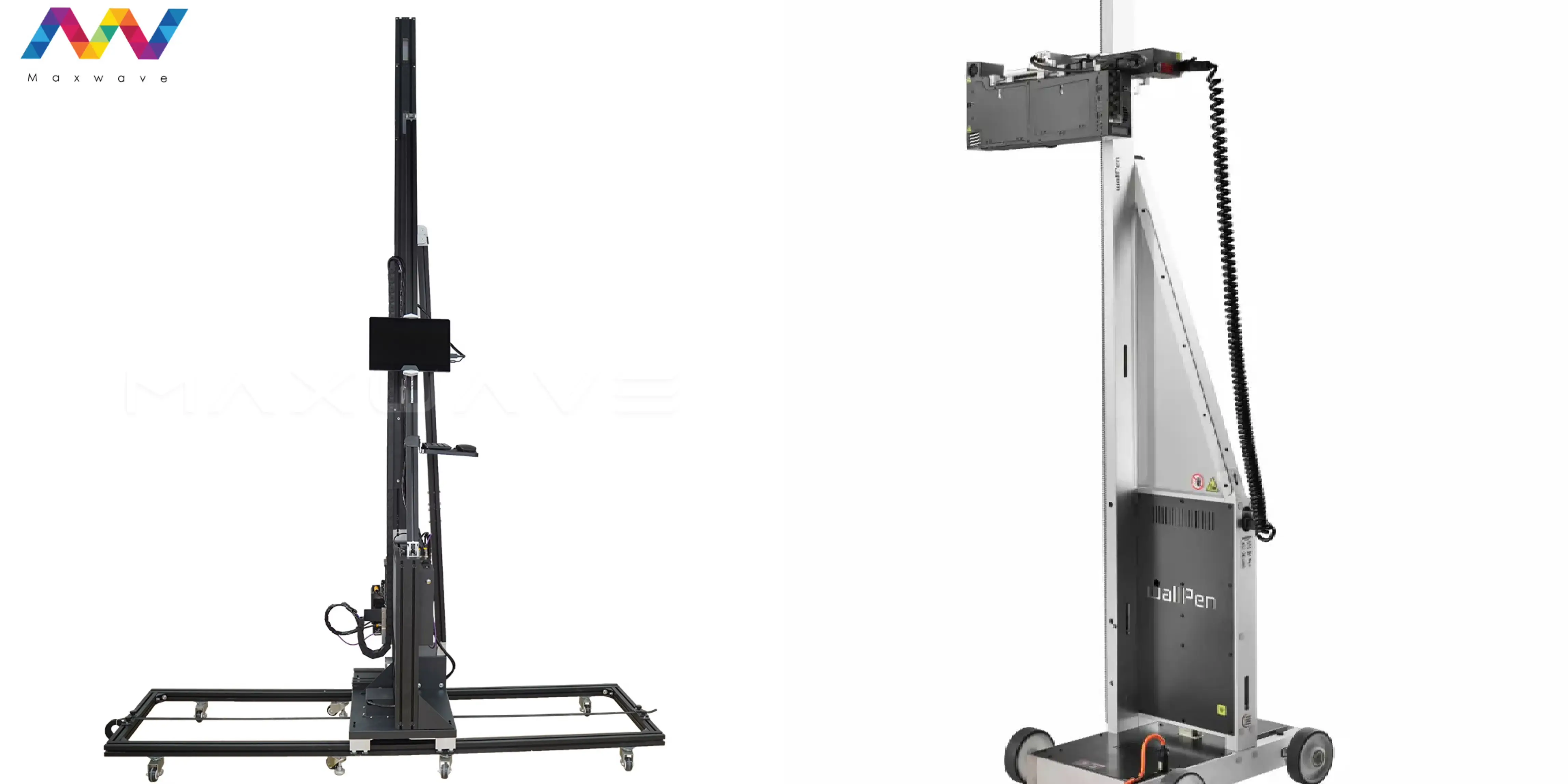
Chinese and European wall printers can look surprisingly similar on a specification sheet.
Both may use recognized Epson printheads, UV-curable CMYK+W ink, automatic wall-distance sensing, high-resolution printing, and portable vertical frames.
Yet the purchase price can be dramatically different.
So what are you actually paying for?
The simplest answer is:
Chinese wall printers generally offer a lower entry cost and stronger factory-direct value, while European wall printers usually charge more for localized service, training, distribution, and a more standardized ownership experience.
That does not mean every European printer is better built or every Chinese printer is a budget machine.
The real comparison should focus on what is inside the machine, what support comes with it, and what the printer will cost to keep operating after the initial purchase.
Chinese vs. European Wall Printers at a Glance
Comparison | Chinese Wall Printer | European Wall Printer |
|---|---|---|
Purchase price | Usually lower | Usually significantly higher |
Buying model | Often factory-direct | Often distributor or regional sales network |
Core hardware | Varies widely by manufacturer | Generally more standardized by brand |
Print quality | Can be excellent with good components and calibration | Generally consistent on established systems |
Configuration options | Usually highly flexible | More standardized packages |
Training | Usually online training | Local or on-site training more common |
Technical support | Mostly remote | Local service more likely |
Spare parts | Usually inexpensive, but logistics matter | Often more expensive, with stronger regional support |
Best for | Startups, small businesses, value-focused buyers | High-volume businesses prioritizing service and uptime |
Main trade-off | Supplier quality must be evaluated carefully | Much higher initial investment |
The difference is therefore less about China vs. Europe and more about factory-direct equipment vs. premium regional support models.
1. Purchase Price: Why Are Chinese Wall Printers Cheaper?
Price is usually the first major difference buyers notice.
Chinese wall printer manufacturers often sell directly from the factory or through a relatively short distribution chain. That reduces dealer margins, local showroom costs, technician networks, and other regional overhead.
European brands may include more of those costs in the purchase price.
A higher-priced package may include local demonstrations, installation, operator training, local warranty handling, spare-parts stocking, and technical service.
That means comparing only the machine price can be misleading.
Imagine two quotations:
One includes only the printer, software, and starter ink.
The other includes delivery, installation, training, spare parts, an extended warranty, and local service.
The second quotation may be substantially higher without the actual printing hardware being proportionally more expensive.
Always compare what is included—not simply the number at the bottom of the quotation.
For startups and smaller mural businesses, the lower capital requirement of a Chinese factory-direct system can be a major advantage because more budget remains available for marketing, transportation, ink, and customer acquisition.
For larger commercial businesses, paying more upfront for local support may be easier to justify.
2. Is a European Wall Printer Actually Better Quality?
Not automatically.
“European quality” and “Chinese quality” are too broad to be useful purchasing specifications.
Many wall printers use components sourced internationally. Two brands from different countries may even use the same Epson printhead while using completely different motors, rails, sensors, electronics, ink systems, and software.
What buyers should compare is the actual machine.
The most important components include the printhead, motion system, frame, wall-distance sensors, white-ink circulation, control electronics, RIP software, and UV curing system.
A well-built Chinese wall printer using a recognized printhead, stable motion control, good sensors, and properly engineered white-ink circulation can produce professional commercial murals.
A poorly designed machine does not become better simply because it carries a higher price.
The reverse is also true.
European manufacturers may justify their premium through tighter quality-control procedures, standardized configurations, documented calibration, more mature software, and better regional service.
Country of origin is a useful buying context—not a substitute for inspecting the machine itself.
3. Print Quality: Will Customers See a Difference?
This is where buyers often expect the biggest gap, but it is not always where the biggest difference appears.
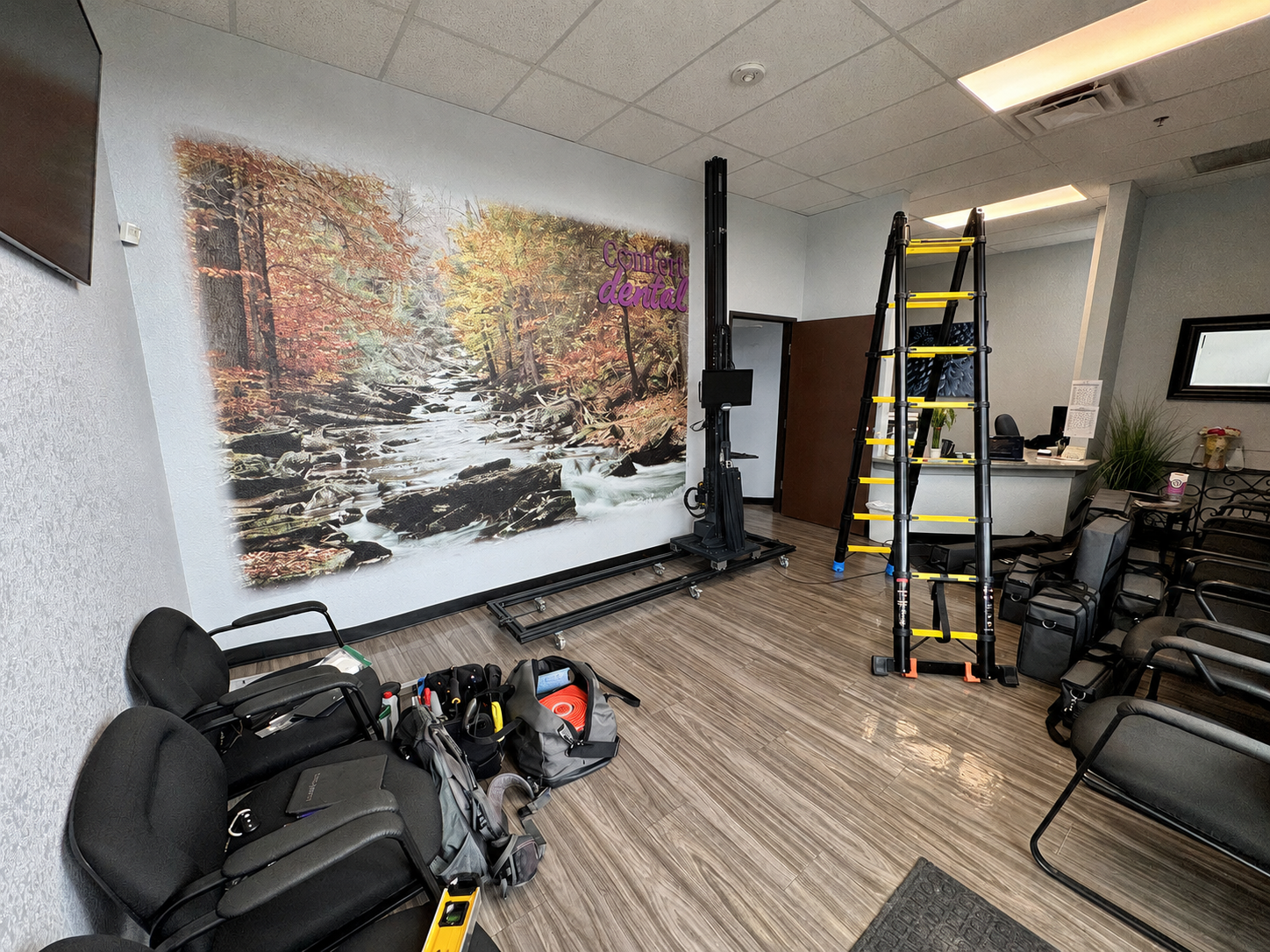
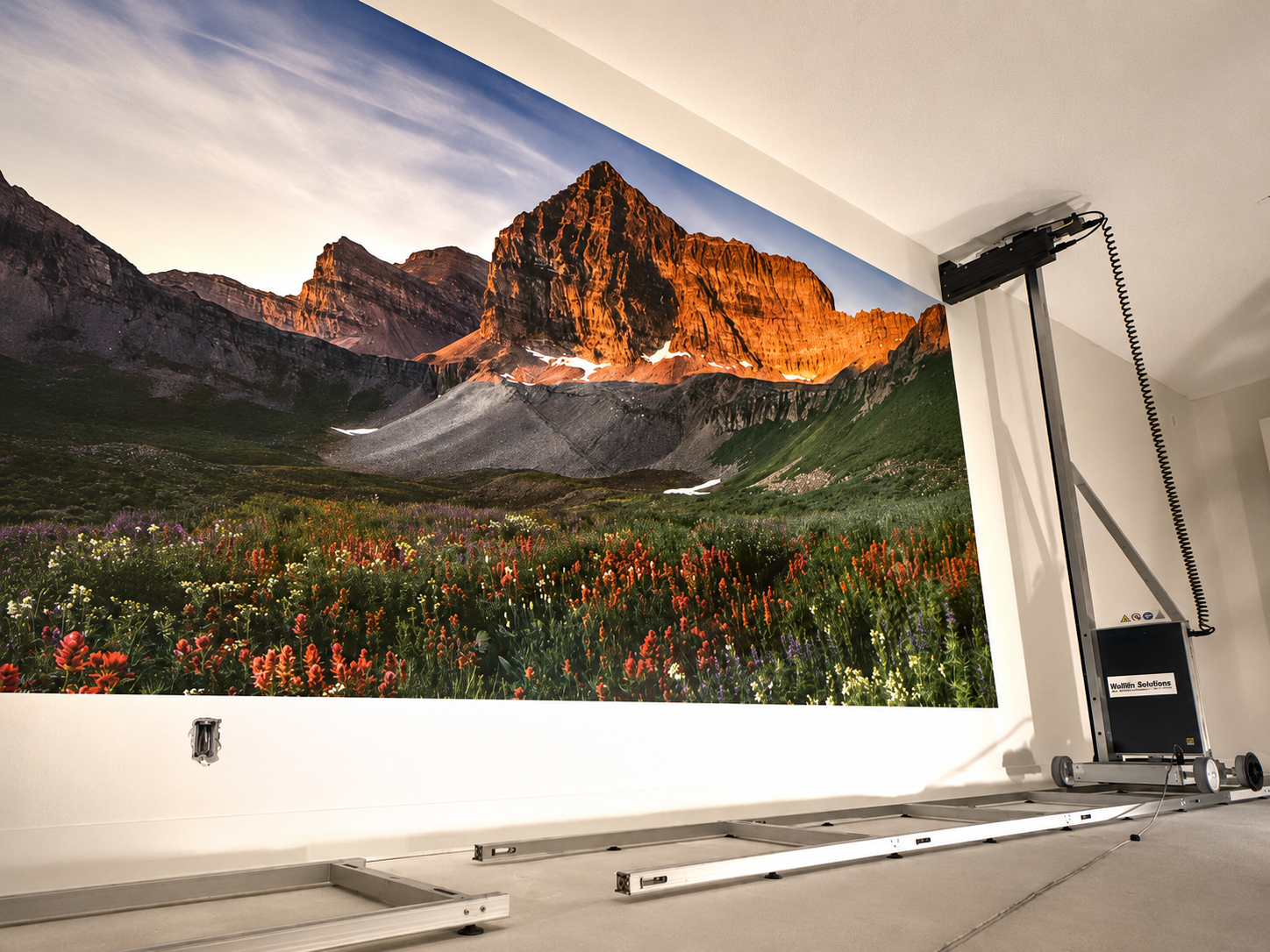
A properly calibrated Chinese and European wall printer machine using comparable printheads and inks may both produce excellent photographs, gradients, text, logos, and murals.
The visible difference often becomes more apparent in repeatability rather than one perfect sample print.
Can the printer reproduce similar color tomorrow?
Does the image remain aligned across a long wall?
Does white ink remain stable?
Does calibration stay consistent after transportation?
Can the operator restart accurately after a pause?
Does the machine maintain print quality during repeated commercial jobs?
These questions tell you more about professional quality than a supplier's best showroom mural.
Do not compare machines by maximum DPI alone.
A stable 720 or 1440 DPI production mode can be far more valuable than a theoretical 2880 DPI mode that is extremely slow or difficult to maintain.
The quality that matters is the quality you can reproduce reliably on paying customer projects.

4. Printhead and Ink System: What Really Affects Ownership Cost?
The printhead is one of the most important long-term cost items in any wall printer.
Before purchasing, ask for the exact printhead model rather than accepting terms such as “industrial printhead” or “Epson compatible.”
Also request the current replacement price and availability.
This matters regardless of whether the printer comes from China or Europe.
Ink management is equally important.
A UV wall printer using white ink should have an effective circulation or agitation system because white pigment settles more easily than standard CMYK ink.
Poor white-ink management can create blocked filters, nozzle problems, inconsistent white coverage, and additional maintenance.
Buyers should therefore compare:
Ink price per liter, expected consumption under the same test image, white-ink maintenance requirements, cleaning-fluid costs, and whether third-party ink affects the warranty.
Lower ink prices are attractive only when the system remains stable.
5. Support Is Often the Biggest Difference
This is one area where a European system may justify a substantial premium.
A regional supplier may provide local installation, in-person training, telephone support, and technicians who can visit the customer.
Factory-direct Chinese suppliers normally rely more heavily on remote support through video calls, messaging platforms, remote desktop software, manuals, and replacement parts shipped internationally.
That model can work very well when the machine is designed for modular maintenance and the operator is comfortable performing basic troubleshooting.
It becomes more challenging when the business cannot tolerate downtime or does not have anyone willing to maintain the equipment.
The important questions are:
Who diagnoses the problem?
Can I replace the component myself?
Where are critical spare parts stored?
How quickly can they be dispatched?
What support is available after the warranty expires?
A cheaper wall printer machine with excellent remote engineering support may be a better ownership experience than an expensive machine with a weak local distributor.
Likewise, a high-volume commercial operation may reasonably pay more for a technician who can reach the site quickly.
Service quality matters more than the country printed on the machine label.
6. Training: Remote vs. On-Site
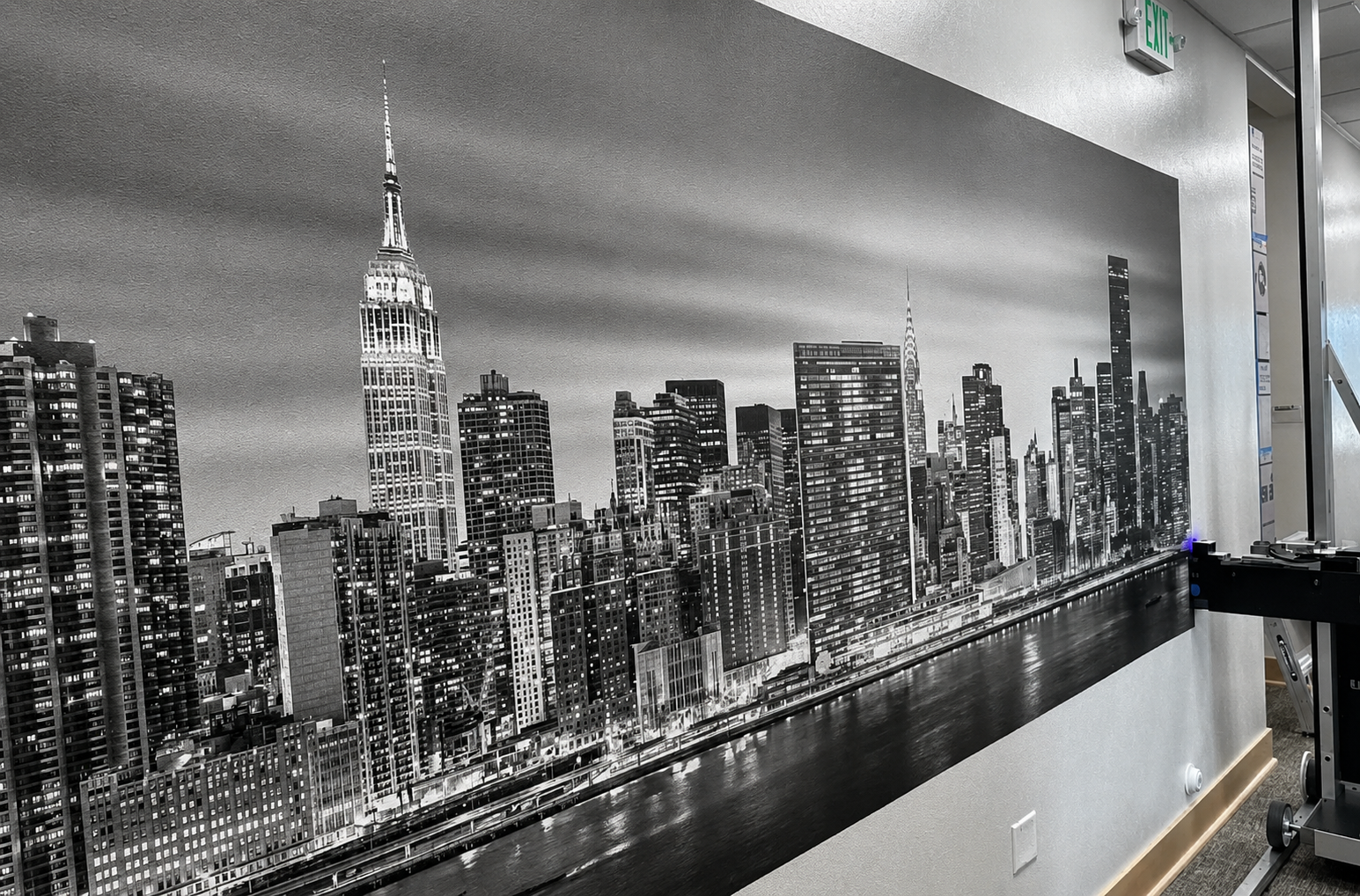
Wall printing machines are easier to operate than many industrial printing systems, but they still require training.
Operators need to understand machine assembly, wall inspection, calibration, artwork preparation, RIP software, white ink, nozzle maintenance, distance sensing, troubleshooting, and shutdown.
Chinese factory-direct manufacturers commonly provide remote training.
This can include videos, manuals, live video calls, and remote software assistance.
European suppliers are more likely to package local or on-site instruction into the higher purchase price.
Which model is better depends on the buyer.
A technically confident owner-operator may learn quickly through remote support and prefer saving thousands on equipment.
A company training several employees may value structured on-site instruction much more highly.
Do not simply ask:
“Is training included?”
Ask what the training actually covers and whether new employees can receive training later.
7. Spare Parts and Maintenance
All wall printers eventually require consumables and replacement parts.
That includes printheads, dampers, filters, wipers, pumps, sensors, belts, motors, UV components, and control electronics.
Chinese replacement components may cost less, but the buyer needs to understand international shipping and availability.
European parts may cost more, but regional stocking can make urgent replacement easier when the distributor maintains inventory.
This difference becomes increasingly important as the business grows.
For an operator completing a few murals per month, several days of downtime may be inconvenient.
For a company with hotels, retailers, or commercial contractors waiting for scheduled projects, the same downtime can be expensive.
A practical strategy for factory-direct buyers is to purchase a small spare-parts package together with the machine.
For example, WallPrintBox can provide commonly needed maintenance parts with the initial system, reducing dependence on emergency international shipments after the machine is already in commercial use.
The cheapest spare part is the one already available when the machine needs it.
8. Which Has the Lower Total Cost of Ownership?
This is the question that matters more than purchase price.
Total ownership cost can be simplified as:
Machine + Delivery + Ink + Maintenance + Parts + Training + Downtime − Resale Value
Chinese systems usually begin with a major advantage in machine cost.
European systems may recover part of their higher purchase price through stronger service infrastructure, easier maintenance support, and potentially stronger resale demand.
But there is no universal point at which one automatically becomes cheaper than the other.
A business printing occasionally may never recover a large European price premium.
A high-volume commercial company may willingly pay that premium if faster support prevents cancelled projects.
Consider two buyers.
Small Wall Printing Startup
A solo entrepreneur has limited capital and expects to complete several residential and small commercial murals each month.
The owner is willing to learn maintenance and use remote technical support.
For this buyer, a professional Chinese factory-direct wall printer may offer the better economic fit.
The lower equipment investment leaves more money for advertising, samples, transportation, and working capital.
Established Commercial Printing Company
A larger company already has scheduled commercial contracts and employees operating the equipment.
Missing a deadline can cost significantly more than the difference in ink price.
For this company, paying more for local service, training, and guaranteed parts availability may make sense.
The value of a European premium increases as the cost of downtime increases.
9. What About Resale Value?
Resale value should matter, but it should not dominate the purchasing decision.
Well-established brands generally have an advantage because future buyers recognize the name and have more confidence in parts and technical support.
Factory-direct Chinese machines may have a smaller secondary market, particularly when the brand is not well known.
However, many small wall-printing businesses buy equipment primarily to generate revenue rather than to resell it several years later.
If you expect to operate the machine for most of its useful life, uptime and operating cost may matter more than future resale value.
If your strategy involves upgrading equipment frequently, brand recognition and secondary-market demand deserve more attention.
10. Which Buyer Should Choose a Chinese Wall Printer?
A Chinese wall printer can make strong financial sense when initial budget matters, the buyer is comfortable with remote support, and the supplier can demonstrate professional hardware and reliable parts availability.
It can be particularly attractive for:
Startups entering wall printing.
Solo operators.
Small decoration companies.
Sign shops testing a new service.
Buyers who prefer factory-direct pricing.
Businesses comfortable keeping spare parts and handling basic maintenance themselves.
The biggest mistake is choosing purely on price.
There is a major difference between a professional factory-direct manufacturer and an unknown marketplace seller assembling the cheapest available components.
Evaluate the supplier as carefully as the machine.
11. Which Buyer Should Choose a European Wall Printer?
European equipment becomes more attractive when the buyer places a high value on local training, standardized service, regional parts supply, and lower operational uncertainty.
It may be a stronger fit for:
Established printing companies.
Large interior-decoration businesses.
Franchise operations.
High-volume commercial contractors.
Companies with multiple operators.
Businesses where project downtime has a high financial cost.
In those situations, paying more upfront can be rational because the business is effectively buying hardware plus service infrastructure.
12. What Should You Compare Before Buying?
Do not ask Chinese and European wall printer suppliers for different demonstrations.
Give both the same test.
Send the same artwork and ask them to print it using the same type of wall or comparable material.
Then compare the finished image, actual print speed, setup process, white-ink performance, distance sensing, software, and ease of restarting after a pause.
Request an itemized quotation including:
The exact printhead.
Ink configuration.
Software.
Starter ink.
Spare parts.
Training.
Warranty.
Shipping.
Replacement printhead cost.
Technical-support terms.
Only then are you comparing two real ownership packages.
A €30,000 machine and an $8,000 machine may no longer look as far apart once every service and accessory is included—or the difference may become even easier to justify.
That is exactly why the comparison needs to happen at the system level.
Conclusion
Chinese and European wall printers represent two different approaches to equipment ownership.
Chinese wall printers generally offer the stronger advantage in upfront price, configuration flexibility, and factory-direct value.
European wall printers generally justify their higher price through local service, structured training, regional support, and a more standardized ownership experience.
But neither origin guarantees quality.
A well-engineered Chinese machine can produce professional murals and operate successfully for a commercial wall-printing business. A European machine can still be poor value if the extra price does not solve a problem your business actually has.
The decision comes down to three questions:
How much capital do you want to invest?
How expensive would downtime be for your business?
How much technical support do you expect the supplier to provide?
For startups and smaller operators comfortable with factory-direct support, a Chinese wall printer can offer a much lower-cost route into professional wall printing.
For established companies where missed deadlines and equipment downtime are expensive, a European system with strong local service may justify the premium.
Do not pay more simply for “European.” Do not buy cheaper simply because it is “Chinese.” Compare the machine, support package, spare parts, and total ownership cost.
Considering a factory-direct wall printer?
Send WallPrintBox your expected monthly workload, typical wall materials, mural sizes, budget, and delivery country. The team can arrange a sample print and provide an itemized quotation covering the machine, software, ink, spare parts, training, and delivery so you can compare the complete ownership package with European alternatives—not just the sticker price.