You've stood in front of a blank wall, phone in hand, scrolling through Pinterest boards and contractor quotes. The decision feels harder than it should. Here's what nobody tells you upfront: choosing between a UV wall printer and traditional wallpaper isn't just a materials question. It's a money question. It's a lifestyle question. And the math looks different depending on your situation — renter, homeowner, or someone building a wall printing business.
This breakdown cuts through the marketing fluff. You get real cost data, honest durability numbers, and recommendations built around your specific scenario. So you can stop second-guessing and start decorating — or investing — with real confidence.
Cost Breakdown and 5-Year Total Ownership Analysis
The sticker price is never the whole story. Material costs, labor, lifespan, replacement cycles — add them all up and the rankings shift in ways that'll surprise you.
Here's the real math across three options: peel & stick wallpaper, traditional wallpaper, and direct-to-wall UV printing. All numbers are based on a standard 100 sq ft wall at mid-range quality. No luxury outliers. No best-case assumptions.
The Full Cost Comparison Table
Cost Dimension | Peel & Stick Wallpaper | Traditional Wallpaper (Pro Install) | Wall Printer (Direct-to-Wall) |
|---|---|---|---|
Material / Equipment Cost | $1.50–$3.00/sq ft → $165–$345 (with 10–15% overage) | $2–$5/sq ft + paste/primer → $230–$575 materials | Ink ≈ $0.40/sq ft → $40 for 100 sq ft + $15k–$40k machine capex |
Installation / Labor | DIY = $0 | $200–$500 labor (≈$2–$5/sq ft) | Service model: rolled into $10–$25/sq ft rate |
Realistic Lifespan | 1–5 years (3–5 years in most interiors) | 10–20 years (most installs hit 10–15 years) | 5–10 years indoors with clear coat finish |
5-Year TCO (100 sq ft) | $150–$500 | $500–$1,000 | $1,000–$2,500 (service) or $15,000+ (owner) |
Breaking Down Each Option
Peel & stick wallpaper wins on upfront cost — full stop. At $1.50–$3.00/sq ft with zero labor expense, a 100 sq ft DIY project runs $150–$345 in materials. The problem is longevity. Most installs start showing edge peeling and surface wear within 3–5 years. This happens faster in kitchens, bathrooms, and high-traffic hallways. Add one partial refresh over five years, and your realistic TCO climbs to $215–$520.
Traditional wallpaper looks expensive upfront — and it is. Mid-range materials plus professional labor puts you at $430–$1,075 installed for 100 sq ft. Here's the part that catches people off guard. Traditional wallpaper lasts 10–15 years, sometimes 20. So you're spreading that upfront cost across a much longer window. Your actual 5-year share of the cost works out to one-third to half of the total. The effective 5-year TCO lands at $500–$1,000. That's competitive — but you have to think in cost-per-year, not purchase price.
Wall printer / direct-to-wall UV printing runs on a different cost model entirely. As a service customer at market rates of $10–$25/sq ft, a 100 sq ft custom mural costs $1,000–$2,500. Seal it with a clear polyurethane or acrylic topcoat and the print holds up for 5–10 years indoors. No replacement needed in that window.
The math changes for owner-operators running a B2B printing business. A $25,000 machine printing 10,000 sq ft per year breaks down to just $0.50/sq ft in equipment cost, plus $0.40/sq ft in ink. That's a $0.90/sq ft technical cost base before labor and overhead. At that point, the inkjet wall printer becomes a real competitor. But a homeowner buying one for a single mural? The 5-year TCO runs into the tens of thousands. The numbers don't work.
The 5-Year Verdict
Lowest 5-year TCO for DIY residential: peel & stick wallpaper at $150–$300 typical
Best long-term value for permanent spaces: traditional wallpaper, cheaper per year over 10–15 year lifespans
Cost-efficient at volume: wall printers earn their place in commercial jobs where equipment cost spreads across dozens of client projects
The numbers don't lie — but the right answer depends on how you're using the wall and who's paying for the work. Keep that in mind as we move into durability and resolution comparisons next.
Customization Freedom: Resolution, Seamless Coverage, and Design Limits
Resolution numbers get thrown around like they mean more than they do. Here's what matters for custom wall decoration: the gap between what each method can print and what your wall needs at viewing distance.
Resolution: What the Numbers Mean
Both wall printers and custom wallpaper target 1440–2880 DPI at final output size. That's the practical range for large-format work — not the 600 DPI you'd demand from a business card. At room scale, 2880 DPI is crisp. Text-heavy graphics benefit from 400 DPI. Beyond that, you're paying for detail no human eye can pick up standing three feet from a wall.
The difference isn't in the dots. It's in how each method handles the space between them.
The Seam Problem Is Real
Wallpaper — including peel & stick — arrives in rolls. Most printable wallcovering workflows require panels at least 48 inches wide. That sounds generous. Then you try covering a 12-foot continuous wall. An installer has to align a repeating forest pattern across three panel joins at eye level. One bad match and the whole mural looks broken.
A direct-to-wall UV printer skips this problem. The design is sized to your exact wall dimensions. It prints edge-to-edge in a single continuous pass. No panels. No alignment math. No seam management.
Surface Adaptability and Design Scores
Traditional wallpaper needs smooth, prepped surfaces. It works best on flat drywall with consistent texture. wall printers handle varied surfaces more easily. That said, manufacturer claims about printing on raw brick or unsealed concrete without primer are worth checking before you quote a client.
Here's where the options land on design flexibility:
Method | Design Flexibility Score | Key Constraint |
|---|---|---|
Traditional wallpaper | 5/10 | Panel width, seam alignment, smooth surface required |
Peel & stick | 7/10 | Still panel-based, seam-limited |
Wall mural printer | 9.5/10 | Room-scale output, custom dimensions, minimal seams |
For full custom wall decoration — a logo wrapping a commercial lobby wall, or a floor-to-ceiling photo in a hallway — the inkjet wall printer wins on design freedom. Wallpaper wins if the design repeats without issue and the budget doesn't stretch to printing services.
Durability and Environmental Resistance: Lifespan and Ink Performance
Five years from now, your wall tells you whether you made the right call. That's the real durability test — not what the spec sheet says, but what still looks sharp after hundreds of cleaning cycles, a bathroom humidity spike, and a full summer of afternoon sunlight.
How Long Each Option Lasts
Strip out the marketing language, and the numbers are straightforward:
Peel & stick wallpaper in real-world conditions — kitchens, sun-facing rooms, humid bathrooms — starts failing at 1–3 years. You'll see edge curl, adhesive loss, and print fade. It's not a flaw; it's just what the material does.
Commercial vinyl wallcovering holds up better. But high-traffic corridors still show scuffing, seam darkening, and edge peel within 2–5 years.
UV direct-to-wall prints on well-prepped surfaces deliver 5–10 years indoors. Add a clear UV-blocking topcoat, and most installs hit the upper end of that range.
What Makes UV Ink Different
UV inks cure under UV light — fast, with no drying time. They don't evaporate like standard inks. Instead, they cross-link into a polymer layer that bonds straight to the wall surface. That chemistry gives UV ink real advantages over water-based and latex options:
Scratch and abrasion resistance: beats water-based inks by a wide margin
Moisture tolerance: works in damp spaces like hospitals, corridors, and bathrooms
Chemical resistance: holds up against routine cleaning agents, as long as nothing abrasive is used
Water-based inks — common in lower-cost wall printers — give you average color longevity at best, with poor humidity resistance. Latex inks do better, but still fall short of UV in abrasion and chemical durability.
The Variables That Shorten Print Life
The ink itself is rarely the first thing to fail. What fails is everything around it:
Direct sunlight breaks down uncoated UV prints outdoors within 2–3 years. Move those same prints indoors, away from direct daylight, and they can last decades under stable conditions.
Poor surface prep does the most damage in the field. Dust, moisture, or a skipped primer step all reduce adhesion. Prints chip and flake long before the ink itself would break down. A clean, primed surface with an optional polyurethane topcoat pushes service life toward the 8–10 year ceiling.
Aggressive cleaning dulls surface gloss over time. UV prints handle this better than most options, but abrasive pads will win in the end.
Durability Score at a Glance
Method | Indoor Lifespan | Humidity Resistance | Cleaning Tolerance |
|---|---|---|---|
Peel & stick | 1–3 years (tough conditions) | Low | Poor |
Vinyl wallcovering | 2–5 years | Medium | Moderate |
UV wall print (coated) | 5–10 years | High | Good |
For permanent commercial spaces or any wall that sees real traffic, UV direct-to-wall printing is the clear winner here — and it's not close.
Construction Complexity, Labor Requirements, and Time Efficiency
The clock starts the moment you move the first piece of furniture away from the wall. What happens next — and how long it takes — sets these three methods apart more than most people expect.
Traditional Wallpaper: High Skill, High Complexity
Pasted wallpaper is a multi-stage process. Every step depends on the one before it. Wall inspection. Repairs. Skim coat. Sanding. Primer. Then paste mixing, panel booking, pattern alignment, hanging, seam rolling, trimming — and cleanup after all of it.
Skip one step, and the next step makes you pay for it.
A 350–450 sq ft room needs 1–2 skilled installers and 8–16 labor hours — a full one to two days. That doesn't count drying time, which adds several more hours before the space is usable. In humid conditions, that wait stretches to 24 hours.
Pattern misalignment, air bubbles, and paste bleed are not rare edge cases. They are the standard failure modes. A panel goes wrong? You pull it and start that section over. You do not patch it. Rework rate is highest here, by a wide margin.
Building commercial speed on traditional wallpaper takes 6–12 months of regular work. Complex murals take longer.
Peel & Stick: Faster, But Still Panel-Based
Peel & stick cuts the complexity by a large amount. No paste chemistry. No drying window. One installer can finish a standard room in 6–10 hours, and the space is ready to use right away.
Panels go off-plumb? You reposition them. That alone removes a whole category of expensive rework. Training time drops from months to weeks.
Some limits still apply — wall plumb, surface texture, and corner geometry all affect the final result.
Wall Printer: Front-Loaded Setup, Then Automated Execution
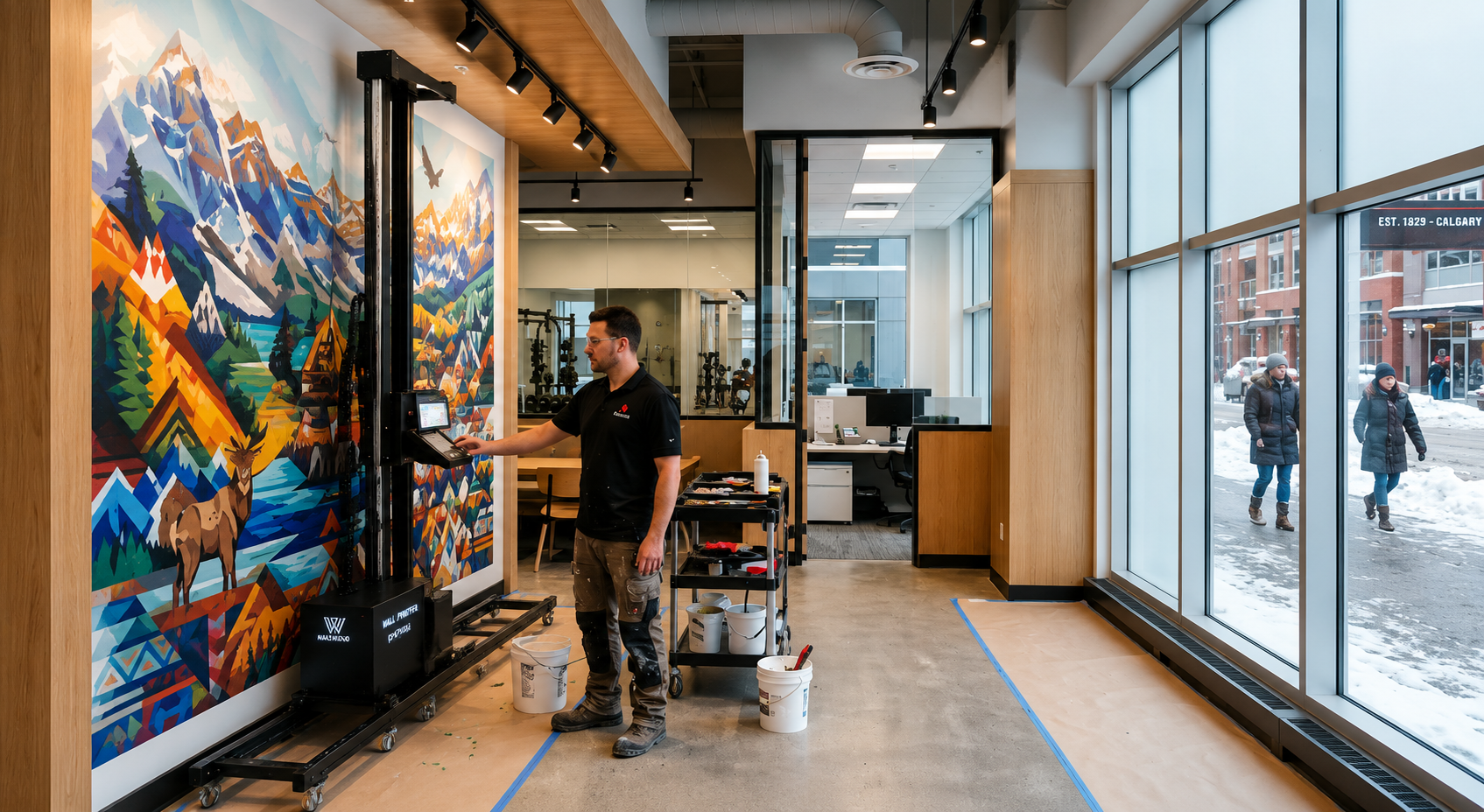
A direct-to-wall UV printer moves complexity around rather than removing it. The hard work happens up front: leveling the rail or mast, aligning the digital file, calibrating standoff distance from the wall surface. Get those right, and the machine takes over from there.
For a 40 sq ft feature wall, the full workflow looks like this:
30–45 minutes: setup, leveling, file alignment
45–60 minutes: automated print pass
15–20 minutes: inspection, optional clear coat
Total: ~2 hours, one operator
UV ink cures on contact. No drying time. No seam management. The room is ready the moment the operator packs up the rail.
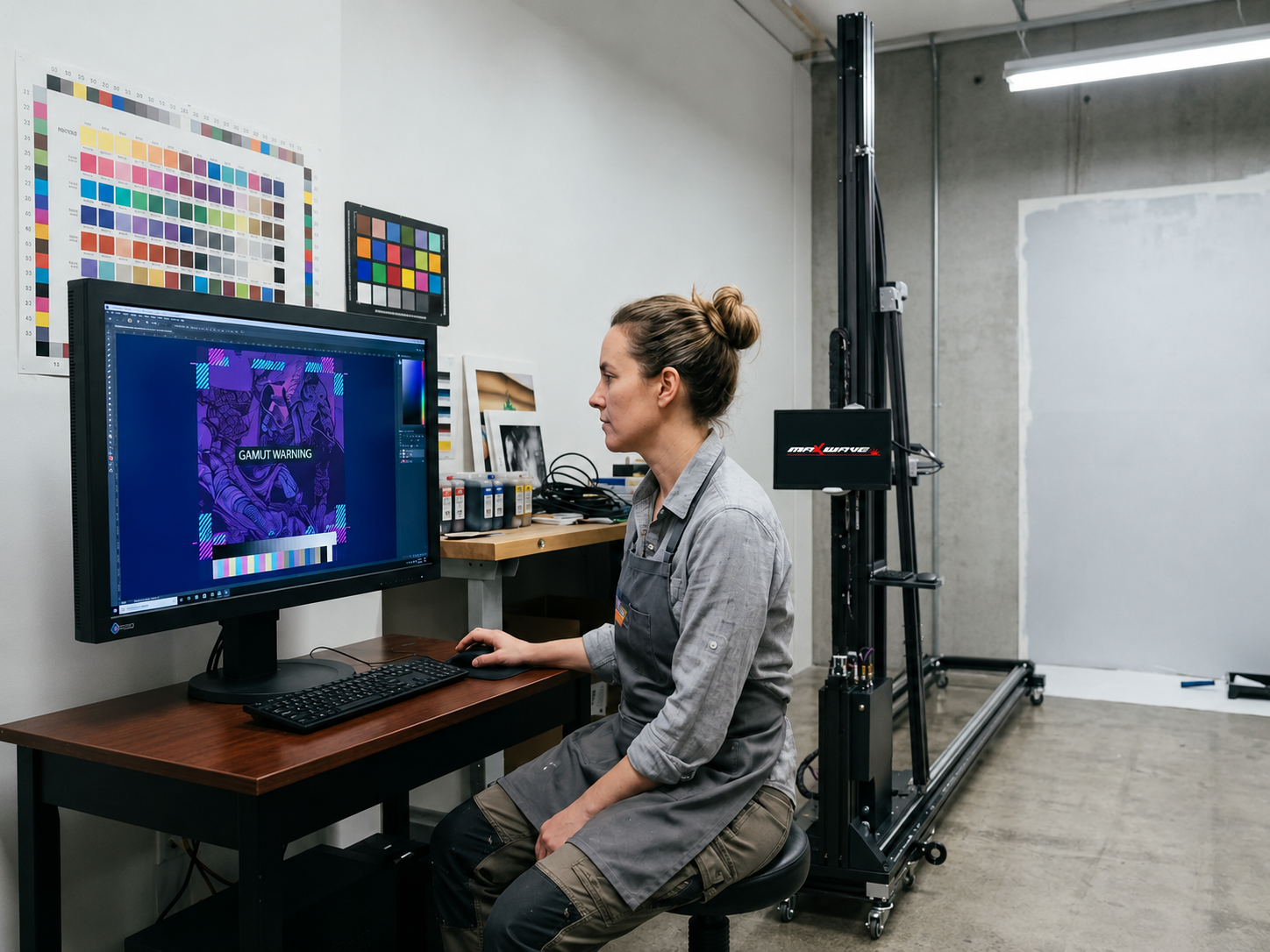
The skill set shifts from hands-on craft to technical operation. You need basic file prep — resolution, color space, scaling — plus the ability to calibrate the machine. Most printer vendors get you there in 2–5 days of training, with a few real projects to build confidence.
The Speed and Complexity Scorecard
Method | Crew | Labor Hours | Drying Wait | Skill Type | Speed & Ease Score |
|---|---|---|---|---|---|
Traditional pasted wallpaper | 1–2 | 8–16 hrs (room) | Yes (up to 24 hrs) | High manual craft | 4/10 |
Peel & stick wallpaper | 1 | 6–10 hrs (room) | None | Medium | 8/10 |
UV wall printer | 1 | ~2 hrs (40 sq ft) | None | Low manual, medium technical | 9/10 |
For a studio operator running back-to-back client projects, the wall printer's 2-hour feature wall cycle is a real business advantage. One operator. Multiple walls in a single day. That's not a spec sheet claim. That's what the workflow delivers once setup is dialed in.
Maintenance Costs, Eco-Friendliness, and Material Sustainability
The wall you decorate today creates waste tomorrow. Most comparison guides skip that part of the decision.
Here's how the three options compare on sustainability and ongoing upkeep — and the gaps are bigger than you'd expect.
VOC Emissions and Waste Profile
Traditional vinyl or PVC wallpaper puts the heaviest strain on the environment. The materials release VOCs during and after installation. The adhesive systems add yet another chemical layer on top of that. Removal day comes for every wall, and you're left with mixed-material waste that most recycling programs won't take.
Peel-and-stick is a step up. Water-based inks, PVC-free substrates, no wet adhesive. Removal is cleaner, and the installation footprint is smaller.
Direct-to-wall UV printing is the strongest option here. Print-on-demand means no overproduction waste. Low-VOC or solvent-free inks are standard on modern equipment. Plus, localized printing cuts transport emissions at the source.
Method | Eco Score | Key Issue |
|---|---|---|
Traditional wallpaper | 5/10 | VOC-heavy adhesives, non-recyclable waste |
Peel & stick | 6/10 | Better removability, still material-dependent |
UV wall printer | 9/10 | Low-VOC inks, on-demand production, minimal surplus |
Maintenance: What Happens After Year One
Traditional wallpaper punishes you for normal life. A scuff, a stain, an edge that lifts — fixing any of it means partial removal, pattern re-matching, and a trip back to the supply house. You're also hoping the colorway is still in stock. Spot cleaning with anything stronger than a damp cloth risks loosening the adhesive or damaging the print layer.
UV wall prints are different. A clear protective topcoat makes the surface washable. Mild detergent. Done. Damage a section? You don't replace the whole wall. You digitally repatch the affected area. That's a maintenance model that fits how real buildings actually get used.
Scenario-Based Recommendations for Home, Commercial, and Rental Spaces
The right tool depends on the wall's job. Three scenarios come up in real decision-making. Each one has a clear answer — once you match the method to what the space needs.
Scenario 1: Primary Homes — Permanent Walls That Earn Their Keep
For owned homes, direct-to-wall UV printing makes the most sense for custom decoration. You're not leaving. The wall isn't temporary. A photo-realistic mural printed at 1440 DPI on your living room feature wall delivers something no panel-based wallpaper can match: no seams, no alignment math, no panel edges breaking up the image at eye level.
Rooms where wall printers outperform every alternative:
Living rooms: Floor-to-ceiling murals printed onto painted drywall or plaster. Done in a few hours — not a multi-day install
Kids' rooms and nurseries: UV-cured ink resists wiping, fading, and the chaos kids bring to walls. Kids outgrow the characters? Repaint and reprint. No peeling, no re-papering
Hallways and stairwells: These narrow, continuous runs are where wallpaper seam alignment breaks down. A panoramic family photo collage or landscape scene printed as one continuous pass removes that problem for good
One practical advantage most homeowners miss: no mounting hardware. The art sits flush to the wall — no frames, no brackets, no gallery logistics. UV ink cures on contact. The room is usable the same day.
Scenario 2: Commercial Spaces — Where Brand Consistency Justifies the Investment
Restaurants, retail stores, corporate offices, schools — these spaces share one core requirement. Brand graphics must be precise, repeatable, and tough enough to survive daily cleaning.
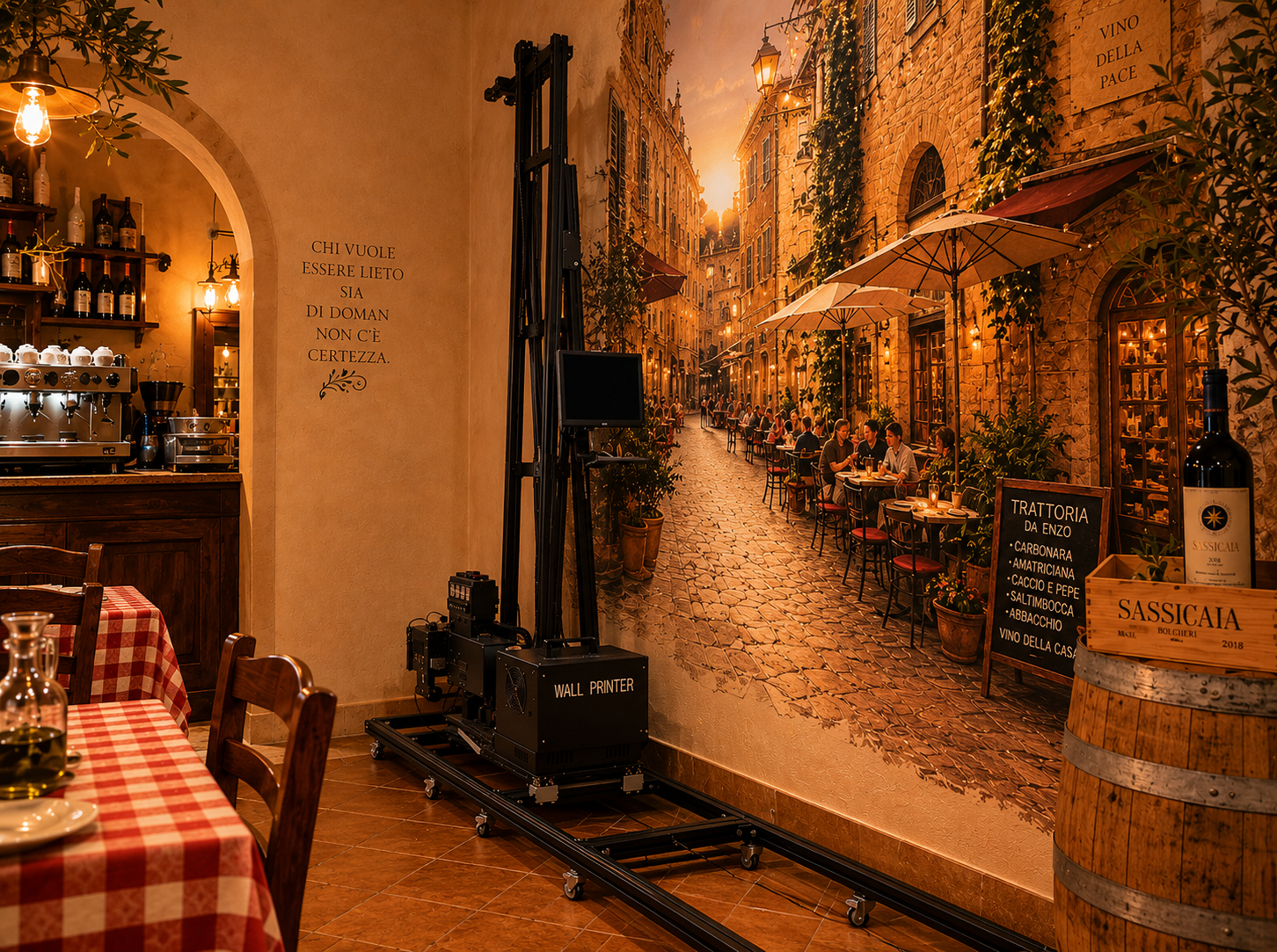
Manual painting introduces variation. Wallpaper introduces seams. A commercial-grade inkjet wall printer prints your logo at the same DPI, the same color values, every single time — on plaster, concrete, glass, tile, and wood. Surfaces wallpaper can't stick to at all become printable brand canvases.
The commercial ROI case is solid:
The U.S. custom printing market hit $6.10 billion in 2023, with artwork segments growing at 11.5% CAGR through 2030
One documented case: a small European wall printing operation increased profits by 40% after shifting focus to high-profile commercial contracts
Operators running steady commercial service work cite machine ROI timelines of 6–12 months
Commissioning print services at $10–$25/sq ft makes sense for one-off installations. Equipment ownership pays off once you're printing multiple commercial spaces per month.
High-traffic durability matters too. Schools, hospital corridors, and retail fitting rooms need walls that hold up to cleaning agents without breaking down. UV-cured inks handle that. Standard wallpaper adhesives don't.
Scenario 3: Rentals, Staging, and Pop-Ups — Reversibility Is the Whole Point
Renters have one hard rule: leave the walls as you found them. That rules out direct-to-wall printing. It makes peel-and-stick wallpaper the go-to choice.
Use cases where peel-and-stick is the right call:
Rental apartments: Accent walls behind sofas or beds, kitchen backsplash areas outside heavy moisture zones — style upgrades that survive lease inspections
Real estate staging: A visual refresh for 3–90 days before a sale closes doesn't need a permanent install. Peel-and-stick goes up in 30–90 minutes per wall and comes down in under 30 minutes
Trade show booths and brand pop-ups: Venues prohibit permanent changes. Peel-and-stick works within that rule and still delivers a themed environment
The cost here is low by design. At $2–$5/sq ft for quality peel-and-stick material, a temporary accent wall doesn't need a business case. You need a measuring tape and an afternoon.
Know the limits before you commit. High-moisture zones see edge lifting. Pattern repeats create visible seams. Want a photo-realistic single-image mural? Peel-and-stick panels can't match what a high-DPI wall printer produces. These are two different categories of output.
The Hybrid Play: Permanent Foundation + Seasonal Flexibility
Some spaces need both tools. A boutique hotel is the clearest example. The lobby mural, elevator branding, and corridor theming are permanent — printed to the wall and built for years of heavy use. The lounge accent wall rotates three or four times a year for seasonal promotions. That's a peel-and-stick job. Reprinting core brand graphics every quarter wastes money and time.
The same logic fits mixed-portfolio landlords managing both long-term and short-term rentals. Long-term units get wall-printed accent walls that support higher rents and need almost no upkeep. Airbnb units keep neutral base walls and use peel-and-stick overlays to shift themes between guest stays fast.
Space Type | Best Method | Why |
|---|---|---|
Owner-occupied home | UV wall printer | Permanent, seamless, durable for years |
Commercial / brand space | UV wall printer | Brand precision, substrate flexibility, high-traffic resistance |
Rental apartment | Peel & stick | Non-destructive, reversible, deposit-safe |
Staging / pop-up / events | Peel & stick | Fast install/removal, low cost per cycle |
Boutique hotel / mixed-use | Both | Printer for core identity; peel & stick for seasonal refresh |
The pattern holds: wall printers belong on walls that aren't going anywhere. Peel-and-stick belongs on walls where permanence is a problem. In spaces that need both, running the two methods side by side isn't a compromise — it's the smartest way to use each tool for what it does best.
Quick Decision Flowchart for Custom Wall Projects
Four questions. Thirty seconds. One clear answer.
Run your project through this logic in order — stop as soon as a branch fits your situation.
Step 1: What's your total budget?
$500 or under → Peel & stick wallpaper. Stop here.
Over $500, permanent install, or ROI-focused project → Move to Step 2.
Step 2: Who controls the wall?
You're a tenant, have landlord restrictions, or the install lasts under two years → Peel & stick wallpaper. Stop here.
You own the space, it's a commercial area, or you're committing for 3+ years → Move to Step 3.
Step 3: What does the design need?
Physical texture — woven, grasscloth, or embossed finishes → Traditional wallpaper. Stop here.
Seamless large-scale photos, brand graphics, brick or concrete walls, or a washable surface → UV wall printer. Stop here.
Step 4: Who's doing the work?
DIY weekend project → Peel & stick wallpaper.
Hiring a pro installer → Traditional wallpaper or a commercial wall-printing service.
Setting up in-house production or starting a wall printing business → Buy a direct-to-wall printing machine.
The One-Line Summary for Each Path
Your Situation | Your Answer |
|---|---|
Low budget, temporary, DIY | Peel & stick |
Texture, premium finish, pro install | Traditional wallpaper |
Custom graphics, brand work, irregular walls, long-term use | UV wall printer |
This flowchart won't shrink the decision. But it keeps you from two costly mistakes. First, paying $2,500 for a wall printer job when a $300 peel-and-stick panel does the same thing. Second, covering a commercial lobby with panels that start peeling at the seams six months in.
Conclusion
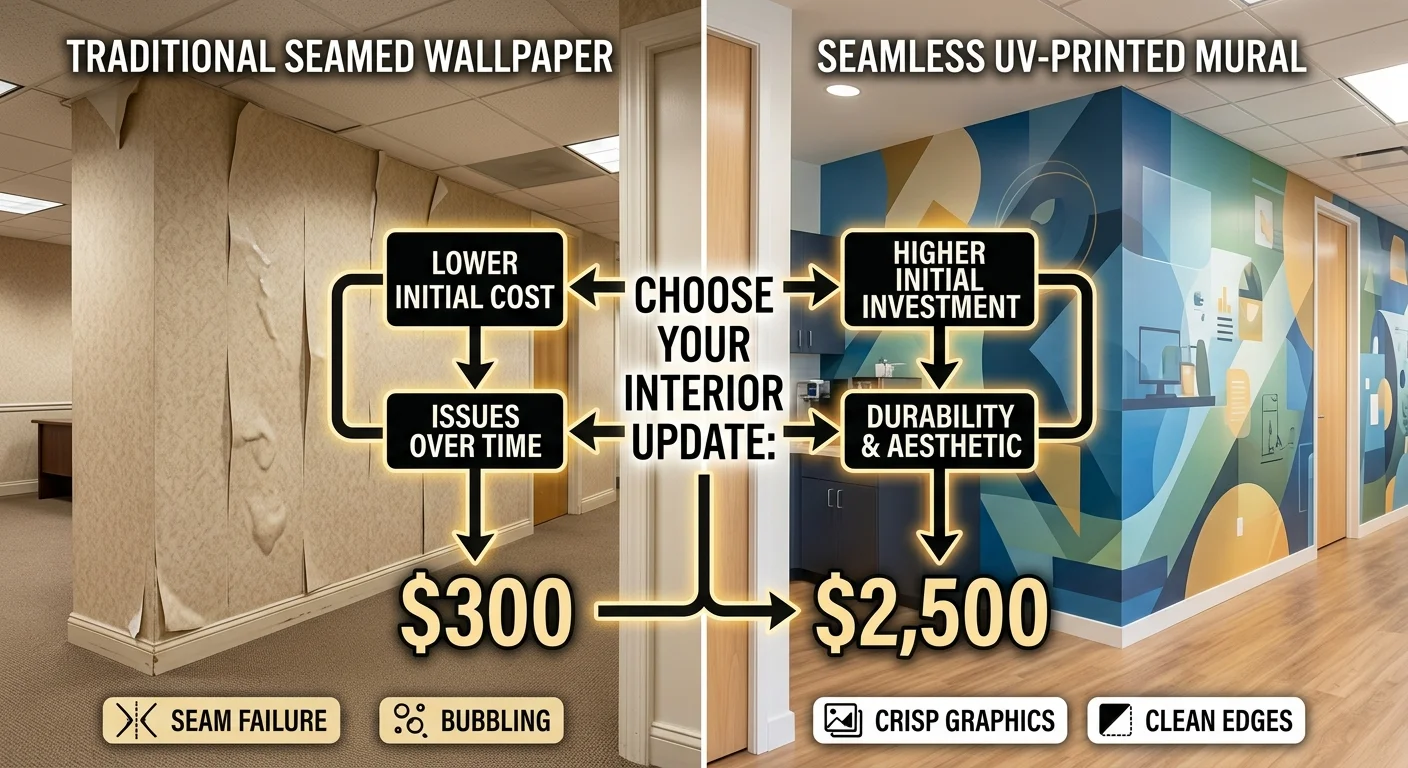
Most comparison articles won't give you a straight answer. Here it is: neither option wins every time — context decides.
Decorating a permanent space? You probably care about pixel-perfect, seamless imagery that won't bubble, peel, or fade by year three. A UV wall printer hits a quality ceiling that custom wallpaper can't match. But furnishing a rental, dealing with an irregular surface, or working on a tight timeline? Quality peel-and-stick or custom wallpaper printing gives you 80% of the visual impact — at a fraction of the commitment.
The real question isn't wall printer vs. wallpaper. It's what does this specific wall need?
Go back to the decision flowchart above. Plug in your budget and scenario. Trust the output. Stop researching. Start decorating.
One last thought: the most expensive wall decoration is the one you redo in eighteen months. That happens when you rush the first decision.
Still comparing wall printer vs. wallpaper for your next project? Visit wallprintbox.com to see how direct-to-wall UV printing can deliver permanent, seamless custom wall decoration — and decide whether it’s the right fit for your space or business.