Ordering a custom wall printer in Italy sounds simple. Then three weeks pass. Supplier emails pile up, nobody confirms CE certification, and your freight forwarder starts asking questions you can't answer.
Italy sits in an awkward spot. It's close enough to German and Spanish distributors to expect European-grade support. Yet it's far enough from major manufacturing hubs that logistics, customs duties, and after-sales coverage all become real negotiating points — before you sign anything.
This guide cuts through that friction. Here's what you get:
A vetted shortlist of suppliers who ship to Italy
A clear breakdown of what each channel costs beyond the sticker price
A step-by-step procurement workflow — from first inquiry to machine installation — built for Italian buyers with a €3,000 to €15,000 budget
wallPen GmbH (German Manufacturing)
The price tag hits first: from €44,000 plus VAT. That's the Wallpen E2, and it stops most casual browsers cold.
Here's what that number buys an Italian operator. The machine ships from Germany — not Guangzhou. It clears Italian customs with zero import duties as an intra-EU shipment. It arrives pre-compliant with every CE and EU machinery directive your workplace safety auditor will ask about. No third-country certificate validation. No customs broker headaches at Genova. A truck leaves Wissen, somewhere between Cologne and Frankfurt, and 2–5 days later it's at your door.
wallPen GmbH was founded in 2016. They manufacture in Germany using regional suppliers. Their core product, the wallPen E2, is a mobile UV vertical wall printer. It runs on a proprietary hardware and software stack protected by over 20 international patents. Setup takes about five minutes. The UV ink system prints onto walls and vertical substrates. Resolution sits in the 300–600 dpi range for this equipment class — check exact specs with their sales team, as wallPen doesn't publish them publicly.
What the package includes at purchase:
- 12-month ink flat rate (24-month available as an upgrade)
- On-site or factory training after delivery
- Marketing materials — photos, videos — to help you start selling the service right away
- Direct access to German spare parts and consumables
Who this makes sense for in Italy:
Buyer Profile | Fit |
|---|---|
Established interior design firm | ✅ Strong |
Commercial signage company | ✅ Strong |
Corporate mural / branding provider | ✅ Strong |
Solo decorator, first machine | ❌ Budget mismatch |
Small start-up, under €20k budget | ❌ Look elsewhere |
The honest limitation: wallPen sells one model. There's no entry-level E1 to ease the commitment. You're either buying the flagship or you're talking to a different supplier. For Italian micro-businesses or decorators testing the large format wall printer market for the first time, the total investment — machine, initial training, marketing ramp-up — will likely overshoot a sensible first-year budget.
For everyone else, the intra-EU logistics story alone cuts significant procurement risk. No import duties. No compliance guesswork. The paperwork arrives with the machine. Contact wallPen via their official site for a quotation, CE Declaration of Conformity, and EMC documentation. German OEMs at this level treat documentation requests as standard — you won't need to chase anything.
wallprintbox.com
Budget reality check: most Italian entrepreneurs looking at wall printing aren't buying a €44,000 German flagship. They're working with €8,000 to €14,000, a van, and a list of local restaurants and hotels that want something on their walls. wallprintbox.com is built around that reality.
The platform offers a complete commercial wall printing solution — machine, software, inks, marketing assets, and training in a single purchase. For a first-time operator in Italy, that matters more than it sounds. You skip the pain of sourcing a bare-bones UV wall inkjet printer from Alibaba. No figuring out Italian RIP profiles, color management, and surface calibration on your own time.
What the package includes:
Direct-to-wall printing technology with print heights of 200–300 cm per pass; mast extension kits go up to 3.5 m
CMYK wall printer ink system, with UV models supporting optional white and varnish channels. Some models also offer CMYK+W+LC+LM for richer colors and smoother gradients.
720–2880 dpi effective resolution; print speeds range from 3–10 m²/h depending on mode
Pre-installed control software with an Italian-language UI — menus, error messages, and a quick-start manual all in Italian
Starter ink kit, spare parts (encoder strips, belts, nozzles), and editable marketing templates
4–8 hours of live remote training via Zoom, plus recorded modules covering assembly, calibration, and maintenance
Pricing benchmark: Units in this category run €6,000–€14,000 ex-works. The final landed cost in Italy adds 20–25% for import duties, VAT, and brokerage — plan your budget around that number.
Italian Logistics and Customs
Shipments enter through Milan (Malpensa) or Rome as primary points. From there, truck delivery covers northern Italy. Standard sea freight takes 30–45 days. Air freight cuts that to 7–10 days for urgent orders.
DDP (Delivered Duty Paid) terms are available at a premium. wallprintbox handles customs clearance for you. For Italian micro-entrepreneurs without a freight forwarder on retainer, that premium is worth it. The HS code for this equipment class is 8443. The landed cost uplift is easy to predict once you know your FOB price.
CE Compliance — What to Ask Before You Pay
This is where Chinese-origin wall art printing equipment deals fall apart for Italian buyers. Get the following in writing before you pay any deposit:
CE Declaration of Conformity referencing LVD 2014/35/EU, EMC 2014/30/EU, and RoHS 2011/65/EU
Actual test reports with lab name and report number — not just a CE logo on the spec sheet
Ink Safety Data Sheets (SDS) in Italian or English with REACH and VOC compliance for indoor use
EU importer or "responsible person" details as required under CE marking regulations
Who This Fits
Buyer Profile | Fit |
|---|---|
First-time wall printing entrepreneur | ✅ Strong — turnkey reduces setup risk |
Decorator expanding into large format wall printing | ✅ Strong |
Ad agency adding mural and retail POP services | ✅ Strong |
Operator needing onsite engineering support fast | ⚠️ Onsite visits are chargeable or slow |
Buyer wanting an established brand with a 10-year track record | ⚠️ Newer entrant — parts availability still building |
Contact: [email protected] or the website inquiry form. Ask for a DDP Italy quotation, a CE documentation package, and the ROI calculation model. Most suppliers in this category have a model that maps your local pricing (€200–300/m²) against ink costs and monthly bookings to show your payback period.
wall printers+ (EU Operational Network)
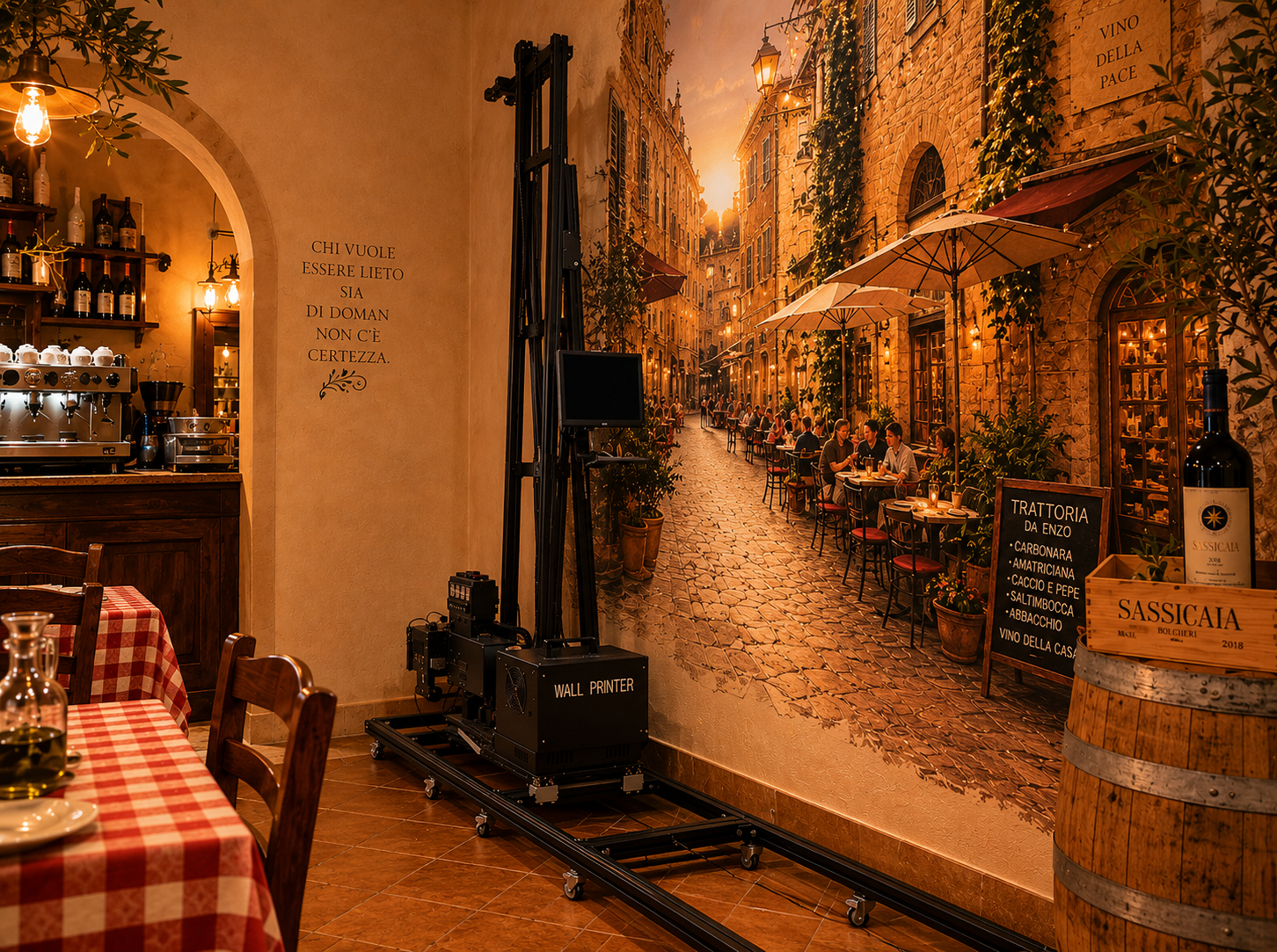
Poland isn't where most Italian buyers expect to find their next piece of capital equipment. But that's where wall printers+ runs its training hub. For operators who want automatic mural printer capability without the China-direct import headache, that geographic detail matters more than it first looks.
wall printers+ runs as a distributed EU operational network — not a traditional single-country dealership. Active since 2022, it targets trades that already have wall access and client relationships — imprese edili, decoratori, cartongessisti, interior design studios — and adds direct to wall printing technology as a billable service on top of existing work. The pitch is simple: send one operator, one printer, charge the job.
What the package delivers:
Vertical CMYK wall printer ink system — prints on plaster, concrete, brick, wood, glass, and select exterior surfaces
Resolution up to 1200 dpi for indoor murals; solvent or UV ink options for outdoor durability
Modular print height up to 3–4 m per pass, with rail extensions for larger walls
Full starter bundle: machine, rails, encoder, positioning system, initial ink set, RIP software, and maintenance kit
One-day operator training at the EU center — small-group, 1:1 coaching format. You get six hours of hands-on instruction covering setup, calibration, routine maintenance, and troubleshooting
Logistics for Italian buyers: Shipments move by pallet freight from Central/Eastern Europe — Poland, Germany, Netherlands. Transit to Italy runs 5–7 working days. This is intra-EU movement, so there are no import duties and no customs clearance delays. CE documentation, risk assessment files, and serial-number-specific declarations all ship with the machine.
The financial picture:
Metric | Benchmark |
|---|---|
Machine investment (EU package) | €20,000–€50,000 |
Ink consumption | 5–10 ml per m² |
Ink cost per m² | ~€2–€5 |
Recommended EU market rate | €120–€150 per m² |
Net margin potential | 60%+ after ink, labor, overhead |
That margin math is part of what wall printers+ sells alongside the hardware. Onboarding covers pricing strategy, client acquisition frameworks — targeting renovation firms, real-estate agents, retail chains — plus marketing kits with brochure templates and sample contracts.
Where the model has limits: The machines are manufactured in Asia and rebranded for the EU network. Deep mechanical customization — different frame geometry, custom electronics, specialized print heads — isn't on the table. Firmware-level changes stay with the original manufacturer. Spare parts and advanced troubleshooting go through the network, so parts lead times and pricing are variables you don't control. The network could also shift strategy over time. Italian buyers would then need to source consumables on their own.
Inquiry process: Fill out the EU regional intake form — linked from their YouTube channel descriptions — and specify your country, business type, and timeline. From there: intro video call → configuration quote → training scheduling → shipment. No distributors in the middle, no cold-email chains.
For a large format wall printer buyer in Italy already running renovation or finishing work, wall printers+ offers a faster start than sourcing from China. Yes, the cost is higher. But that premium gets you EU-compliant documentation, local-timezone support, and a structured business launch plan — not just a machine.
DXonJet / WallPrinterCN (China Direct ODM)
Factory pricing from Nanjing sits between USD 8,000 and USD 15,000 FOB for a complete vertical wall printer. That price range gets Italian buyers to stop and pay attention.
DXonJet runs two websites. dxonjet.com handles global retail and reseller sales. wallprintercn.com is for factory-direct and ODM orders. Same manufacturer, same address in Jiangsu Province — but two separate conversations. Need one machine? Use the retail side. Need five units with your logo on the shell? Go to the ODM side.
The hardware prints murals, advertising graphics, and high-resolution wall art on plaster, concrete, painted walls, and brick. The operator controls output from a mobile device via wireless — useful on scaffolding or in a tight hotel corridor. Every unit goes through a 72-hour aging test before leaving the factory. That's not a marketing claim. It's a real production step that catches failures before the machine reaches Torino.
What to request before you pay a deposit:
CE Declaration of Conformity (with directive references — LVD, EMC, RoHS)
EMC test reports with the lab name and report number visible
Ink Safety Data Sheets confirming REACH and VOC compliance
Explicit warranty wording on printhead coverage — or the lack of it
FOB vs DDP landed cost estimate to Genova, Trieste, or Venice
That last point matters. Under FOB terms, your Italian customs broker takes care of clearance, duties under HS code 8443, and VAT. DXonJet's freight network offers DDP at a premium. For a first-time importer, paying that premium is often the smarter move.
The honest risk profile:
Factor | Reality |
|---|---|
Hardware cost | ✅ Lowest in this guide |
CE documentation | ⚠️ Request and verify — not published on site |
Onsite service in Italy | ❌ No local center — remote support via WhatsApp and Zoom |
Printhead warranty | ❌ Excluded in most cases — budget for replacements |
ODM/OEM flexibility | ✅ Branding, color, software UI — negotiable from ~3–5 units |
Sea freight from Shanghai or Ningbo to North Italian ports takes 30–40 days. Build that into your project timeline. This is not a machine you order the week a job starts.
Primary contact: Alex Wang — [email protected] / WhatsApp +86 159 5205 1055. Find Zoom scheduling links in their YouTube channel descriptions. Send one email asking for a formal Proforma Invoice, the full spare parts pack list, and shipping options to Italy. Alex's team responds Monday–Saturday, 09:00–22:00 China time.HKHR Wall Printer / Italy Local Agent Channel
Most Chinese wall printer manufacturers skip this step entirely: flying their Italian distributors to the Dongguan factory for hands-on training before the first machine ships. HKHR did it.
The visit is on record. A team of Italian agents flew to South China. They walked the assembly workshop, ran test prints on the S-Series, and sat through calibration and maintenance sessions — all before flying home to start selling. That detail counts more to Italian buyers than any spec sheet. The person delivering your machine to a workshop in Lombardy or Brescia has already taken that machine apart and put it back together — in front of the engineers who built it.
The S-Series: what the hardware is
The S-Series UV wall printer is HKHR's main export product. Over 100 units sold across global markets. The vertical rail-and-frame system prints floor-to-ceiling on plaster, concrete, glass, tile, and metal. Indoor murals, commercial wall advertising, exterior graphics with UV-cured inks — this is a high resolution wall printing platform built for operators running real commercial jobs. Not occasional decorative work.
Why the agent channel matters for Italian buyers
HKHR runs an exclusive regional distributor model across Europe. You can't buy direct from the factory as an Italy-based buyer. The factory routes you to the Italian agent. That might sound like an obstacle. It's not — it's a practical setup for buyers who don't want to manage a China import on their own.
Here's what the agent handles for you:
Customs clearance and import VAT — they manage the paperwork; you get a local Italian VAT invoice
Local spare parts stock — printheads, encoders, UV lamps, and pumps held in-country to cut downtime
Italian-language technical support — on-site troubleshooting, not a late-night WhatsApp message to China
EU power and plug configuration — machines arrive ready for 220–240V European standard
CE documentation package — certificate copies, user manual, and warranty terms included
Training hubs are being set up in key industrial areas. Lombardy and Tuscany are the primary locations. Prospective buyers can go see live direct to wall printing technology in action before making any commitment.
What this channel costs
The agent margin adds roughly 10–15% over a factory-direct purchase plus freight, calculated per single unit. On a machine priced in the €8,000–€14,000 range, that's a meaningful number. But look at what drops off your plate: customs brokerage, import coordination, parts logistics, Italian-language onboarding. For a first machine purchase, that premium usually pays for itself.
MOQ is one unit. Italian agents are building out market coverage right now. That means they take single-machine orders from wall décor studios, advertising firms, and construction companies adding automatic mural printer services to their existing operations.
How to reach the Italian agent
Start with HKHR's global sales team. Tell them you're based in Italy. They'll connect you to the current Italian distributor — the regional agent directory stays unlisted by design.
WhatsApp: +86 18510004787
Email: [email protected]
Website: wallprinterworld.com
Ask for the Italian agent contact, an S-Series quote with local delivery included, and the CE documentation package. The Italian agent may have demo stock — request an on-site print demo before you sign anything.
Aspect | Via Italy Local Agent |
|---|---|
Language support | ✅ Italian-language sales and technical service |
Customs and VAT | ✅ Agent-managed; local invoice issued |
Spare parts | ✅ Local stock held by distributor |
CE documentation | ✅ Provided with machine |
Lead time (stocked units) | ✅ Faster than China direct |
Price vs. factory direct | ⚠️ 10–15% premium on single-unit orders |
Deep hardware customization | ⚠️ Limited — route through factory for special configs |
End-to-End Procurement Workflow for Italian Buyers
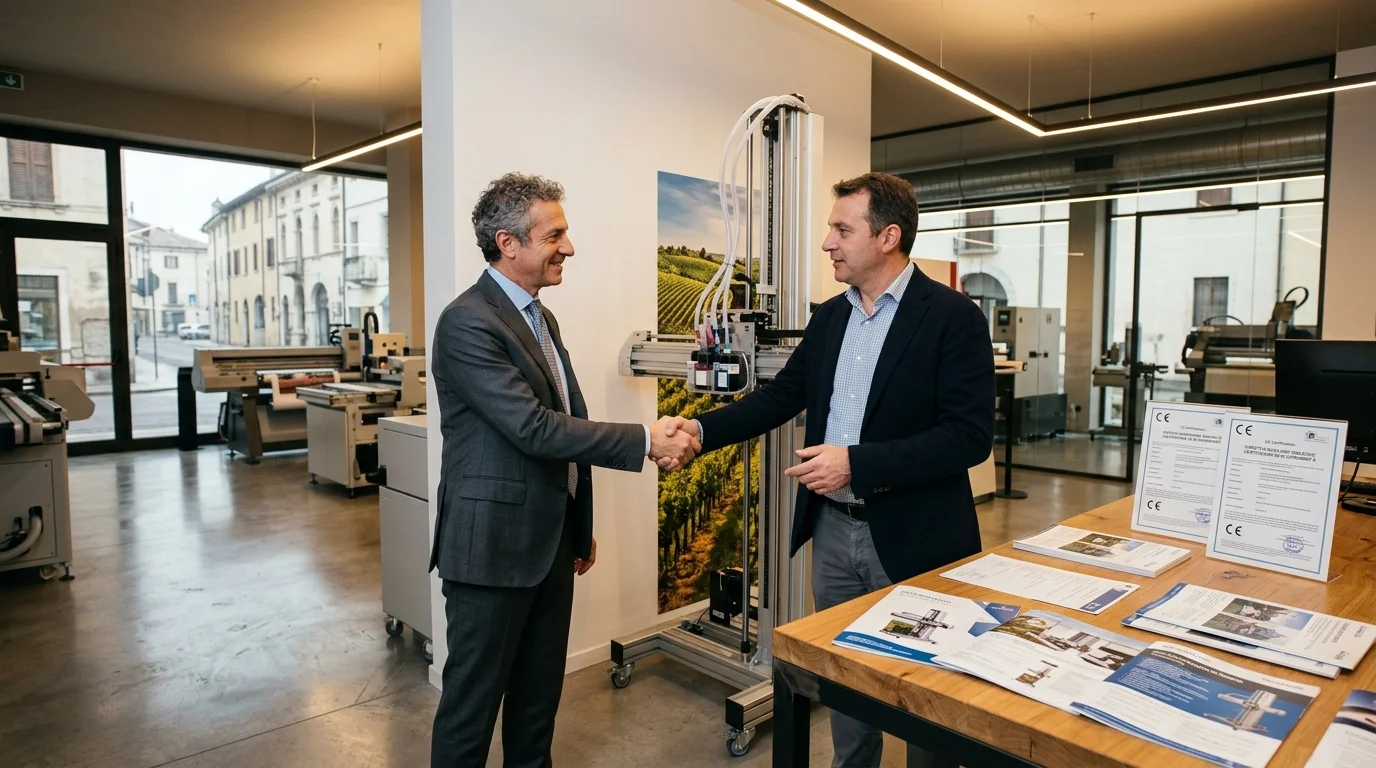
Five suppliers reviewed. One machine shortlisted. Now comes the part most guides skip.
Getting a custom wall printer from inquiry to first paid job in Italy involves eight distinct stages. Each one has a specific failure point. Here's how to move through all of them — without losing a deposit, missing a customs deadline, or taking delivery of a machine that fails Italian electrical standards.
Stage 1: Write a Real RFQ
Don't send a generic "please send me your best price" email. Send a requirements sheet. Every serious supplier — German OEM or Chinese ODM — responds better to clear specifics.
Minimum spec requirements to state in writing:
Vertical reach: 2.7–3.1 m to cover standard Italian residential wall heights
Resolution: minimum 720×2880 dpi at production speed — ask for both native and maximum resolution, stated in writing
Print speed: request m²/hour at high-resolution mode on plaster and concrete (industry benchmark: 3–6 m²/h)
Ink type: UV-LED for mixed substrates and outdoor durability; water-based or eco-solvent for schools, hospitals, or low-VOC environments
Ink cost per m²: ask for a real example — 10 m² mural, grams used, price per gram
Compliance items to demand before any conversation continues:
CE Declaration of Conformity referencing LVD 2014/35/EU, EMC 2014/30/EU, and where applicable Machinery Directive 2006/42/EC
Italian-language UI or Italian training materials at minimum
Power draw specification — confirm 230V single-phase compatibility with the Italian grid
MSDS/SDS for all inks in Italian or English, with REACH and VOC compliance noted
Stage 2: Run the Sample Test Before Any Deposit
Request a custom video test on your actual substrate. Ship a concrete panel, a gypsum board (cartongesso), or a plastered sample to the supplier. Ask for:
Full process video: machine setup, alignment, print run, and a macro close-up of the finished output
Pass count, dpi, ink type, and print time — so you can calculate real ink cost and productivity
High-resolution wall printing quality checklist: legible 6–8pt text at 60 cm viewing distance, no banding in gradients, vertical alignment held over 2.5 m, adhesion intact after tape pull
Book a live remote demo. Watch the operator load a job from the Italian-localized RIP software in real time. Confirm the emergency stop works. Confirm the UV lamp shielding is in place.
Stage 3: Lock the Commercial Contract
Four items belong in writing before you pay:
1. Technical annex — model, configuration, print height, dpi, max speed, ink type, accessories list. A supplier who won't include the spec sheet in the contract is a red flag.
2. Warranty scope — standard benchmark is 12 months from installation or 2,000–3,000 operating hours. Get clarity on which components count as consumables: printheads, UV lamps, filters. Ask for the average spare parts lead time to Italy, in writing.
3. INCOTERMS — two solid options for Italian buyers:
- CIF to Genova, Trieste, or La Spezia — supplier covers freight and insurance to port; you handle customs and domestic delivery
- DDP to your Italian address — supplier handles everything, including import duties and IVA; the price is higher, but customs complexity drops to zero on your end
For first-time importers, DDP is worth the extra cost.
4. Payment structure and protection:
- Standard: 30–50% deposit, balance before shipment against shipping documents
- For factory-direct purchases above €50,000: use an irrevocable Letter of Credit through your Italian bank. Specify required documents — commercial invoice, packing list, bill of lading, CE DoC, test report, insurance certificate
- For mid-range orders: B2B escrow through a trade finance intermediary cuts risk for both sides
Add a late-delivery penalty clause: 0.1–0.3% of order value per delayed week, capped at 5%. Also add an acceptance protocol: the machine is accepted only after test prints at your site meet agreed resolution and banding criteria.
Stage 4: Customs Clearance in Italy
This is where unprepared buyers lose days — sometimes weeks.
HS code: Most UV wall inkjet printers and large format wall printers classify under HS 8443.32. Some configurations fall under HS 8479.89. Your supplier will suggest a code. Your Italian doganalista (customs broker) makes the final call. Get both parties aligned before the shipment leaves the factory.
Documents your broker needs — 3–5 days before ETA at port:
Commercial invoice: buyer/seller VAT numbers, HS code, full description ("Vertical UV direct-to-wall inkjet printing machine"), INCOTERM and place, total price in currency
Packing list: crate count, dimensions, gross/net weight
Bill of lading (sea), AWB (air), or CMR (road)
CE Declaration of Conformity
Insurance certificate for CIF or DDP shipments
Italian customs specifics:
- IVA: 22% applied to customs value plus import duty
- Make sure your EORI number is registered and your ATECO code is filed correctly — missing either one triggers clearance delays
- Random physical inspections happen at Genova, La Spezia, Livorno, and Trieste. Budget an extra 1–3 days if your crate gets pulled
Stage 5: Delivery and Arrival Inspection
Before your freight forwarder arranges inland transport, confirm two details most buyers miss:
ZTL restrictions in Italian cities — trucks cannot enter historic centres during restricted hours. Plan your delivery window around this.
Door and corridor clearance at your premises — measure crate dimensions against your actual access points. Have a forklift or pallet jack ready if there's no loading dock.
Check the machine before you sign the POD (Proof of Delivery). Look at crates for damage, tilt indicators, and shock stickers. Photograph everything. Note any damage on the CMR. Within 24–48 hours, open the crates, verify all contents against the packing list, and report anything missing to the supplier and insurer right away.
Stage 6: Installation, Calibration, and First Job
Unboxing checklist — confirm you have:
- Main frame, Z-axis assembly, rails
- Printheads, UV lamp module, ink system
- Spare parts pack: dampers, belts, filters, fuses, capping station components
- Calibration tools: alignment plates, encoder cleaning kit, test charts
- Power cords confirmed for Italian 230V grid
Setup sequence:
1. Level the machine on a stable floor — use a spirit level
2. Run Z-axis calibration: distance sensors to wall
3. Run nozzle check; clean heads before first production print
4. Install Italian-localized RIP software on a dedicated PC
5. Set up color profiles for plaster, concrete, and gypsum board
6. Connect remote support access (TeamViewer or AnyDesk) for supplier diagnostics
Training and first commercial run:
Training — remote or onsite — must cover day-to-day and weekly maintenance routines, file preparation (PDF/TIFF, correct resolution for direct to wall printing technology jobs), and basic color management for brand logos and murals.
Run one real paid job during the training period. Track print time, ink consumption per m², and margin. Use those numbers to set your standard Italian market rate — current benchmarks run €40–€80/m² for mid-tier operators, with high-resolution mural work reaching €120–€150/m² in commercial jobs. That first job also gives you photos and client feedback you can put straight into your sales materials.
By the time training ends, you're not still getting ready. You're already running.
Italian Customs Clearance, HS Codes & Duty Rates
The number that surprises most Italian buyers isn't the machine price. It's the landed cost — what the machine costs after it clears the port at Genova or Trieste and reaches your workshop door.
Here's how to calculate it before you wire a deposit.
HS Code: Two Options, One Correct Answer
Most UV wall inkjet printers and large format wall printers fall under one of two TARIC headings:
HS 8443.32 — digital printers that connect to a data-processing network. Many units under this code qualify as ITA-covered (Information Technology Agreement), which means 0% import duty on Chinese-origin equipment.
HS 8479.89 — special-purpose machinery not listed elsewhere. Duty rate runs 2.7–4.2% MFN, depending on the sub-line.
Your supplier will suggest a code. Your Italian spedizioniere doganale makes the binding call. Get both parties aligned in writing before the shipment leaves the factory. A misclassification doesn't just cost money — it holds your crate at port while customs issues queries.
Practical step: Check the supplier's suggested code in the EU TARIC database yourself before your broker does. It takes ten minutes and catches mistakes before they become problems.
The Real Cost Calculation
Italian customs uses CIF valuation — goods value plus freight plus insurance — as the duty base.
Scenario | CIF Value | Duty Rate | Import Duty | IVA (22%) | Total Tax Hit |
|---|---|---|---|---|---|
8443.32, ITA-covered | €12,000 | 0% | €0 | €2,640 | €2,640 |
8479.89, 3.7% duty | €12,000 | 3.7% | €444 | €2,737 | €3,181 |
IVA applies to the CIF value plus any duty — so the tax base rises when duty applies. For a VAT-registered Italian business, the 22% IVA is recoverable in full as input tax through your periodic VAT return. The duty is not. That gap matters a lot once you stack a 0% ITA-covered classification against a 4.2% catch-all heading — the difference adds up fast on a €12,000+ machine.
Documents Your Broker Needs — Before the Ship Arrives
Submit everything 3–5 days before ETA at port:
Commercial invoice — seller/buyer EORI and VAT numbers, HS code, full description ("Vertical UV direct-to-wall inkjet printing machine"), INCOTERM, total value in currency
Packing list — crate count, gross/net weight, dimensions
Bill of lading (sea) or AWB (air)
CE Declaration of Conformity — required for powered machinery entering the Italian market
Certificate of Origin — sets duty treatment under TARIC
Italian-language safety manual — customs and market surveillance will flag and hold machinery that arrives without one
Miss any of these and you face clearance delays. At Genova, La Spezia, or Trieste, one missing document during a busy week costs 3–7 days minimum.
FOB vs DDP — Which Makes Sense for You
DDP (Delivered Duty Paid): The supplier handles everything — freight, customs clearance, duty, and IVA. Your machine arrives like a domestic purchase. You pay a 15–22% premium over FOB price for that convenience. You also lose direct visibility into what duty and VAT cost, which makes input VAT recovery more complicated.
CIF/FOB: You appoint a spedizioniere doganale at your entry port. You pay duty and IVA straight to customs, then recover the IVA through your tax return. Total cost is lower. Paperwork is on your side.
For first-time importers: DDP is worth the premium — the simplicity alone justifies it. For buyers on their second or third machine, or anyone importing above €20,000 CIF, the FOB route with a solid broker at Genova pays for itself fast.
EU CE Compliance & Safety Verification Checklist
A CE logo on a spec sheet means nothing. What matters is the technical file behind it — and whether a supplier will hand it over.
Any wall art printing equipment entering the Italian market needs a Declaration of Conformity. That document must name every applicable EU directive. For this equipment class, that means three:
2006/42/EC — Machinery Directive
2014/30/EU — EMC
2014/35/EU — Low Voltage Directive
Miss one, and the CE claim is void. Not incomplete. Void.
Request this documentation pack before you pay any deposit:
Full DoC with directive references and issue number
Risk assessment tied to specific safety functions
Test reports from an accredited lab — TÜV, SGS, or Intertek — with lab name and report number visible
Full electrical schematics and a BOM component list
Emergency-stop circuit validation document
A user manual in Italian covering hazards, safe use, and maintenance
For UV-configured machines, add these to your checklist:
Enclosure safety class rating
Interlock switches confirmed on all access panels
Ozone extraction specs
Chemical handling guidance for UV inks
Check the DoC serial number against the manufacturer's certification record. Keep both digital and physical copies. Italian customs and workplace safety auditors can ask for them on the spot. The manufacturer must hold the full technical file for at least 10 years after placing the product on the market.
A supplier who hesitates on any of these items? That hesitation is your answer.
Budget-Optimized Machine Comparison Table (€3,000–€15,000)
Three tiers. Three very different businesses hiding inside them.
The gap between a €3,500 entry machine and a €14,000 commercial unit goes far beyond price. You're looking at print height, head lifespan, calibration workload, and job type — café murals vs. hotel corridors. Here's how each tier plays out for an Italian operator making a real purchase decision.
The Three-Tier Breakdown
Budget Tier | Print Height | Printhead | Resolution | Best For | Key Trade-Off |
|---|---|---|---|---|---|
€3,000–€6,000 | 1.8–2.0 m | Epson DX7 / XP600 | 720–1200 dpi | Solo decorators, market testing | Manual Z-axis; Chinese-only UI; self-sourced spares |
€6,000–€10,000 | 2.5–3.0 m | Epson i3200-U1, Ricoh G5 | CMYK+W, 2–4 pass | Renovation crews, signage shops | Remote training only; dual-head alignment takes real skill |
€10,000–€15,000 | 3.2–4.0 m | Ricoh G6, Kyocera KJ4 | 1200–2400 dpi effective | Mural studios, high-volume commercial | Heavy shipping; 2-person handling required; large capital outlay |
Where the Real Money Goes
For a €10,000 total project budget, a practical split looks like this:
~€7,000 — machine hardware
~€1,500 — consumables starter stock (8–12L UV ink, primer, cleaning fluid)
~€1,000 — critical spares: two printheads, encoder strips, dampers, filters
~€500–€800 — Italian port logistics, customs brokerage, last-mile delivery
Cut the spares budget and one dead printhead on a commercial job wipes out your margin for the entire month.
ROI Reality Check
A direct to wall printing technology workflow at 10 m²/day and €40/m² brings in €400/day gross. At that output, a machine in the €6,000–€12,000 range breaks even within 3–5 active commercial months. That assumes 8–12 production days per month and ink costs held under 50% net margin.
Entry-tier buyers hit break-even sooner on paper. In practice, manual calibration, more frequent downtime, and lower rates on corporate high resolution wall printing jobs drag out the real return.
Bottom line: The €6,000–€10,000 prosumer tier is the best risk-adjusted starting point for an Italian operator who plans to sell on a steady, consistent basis — not just once in a while.
Conclusion
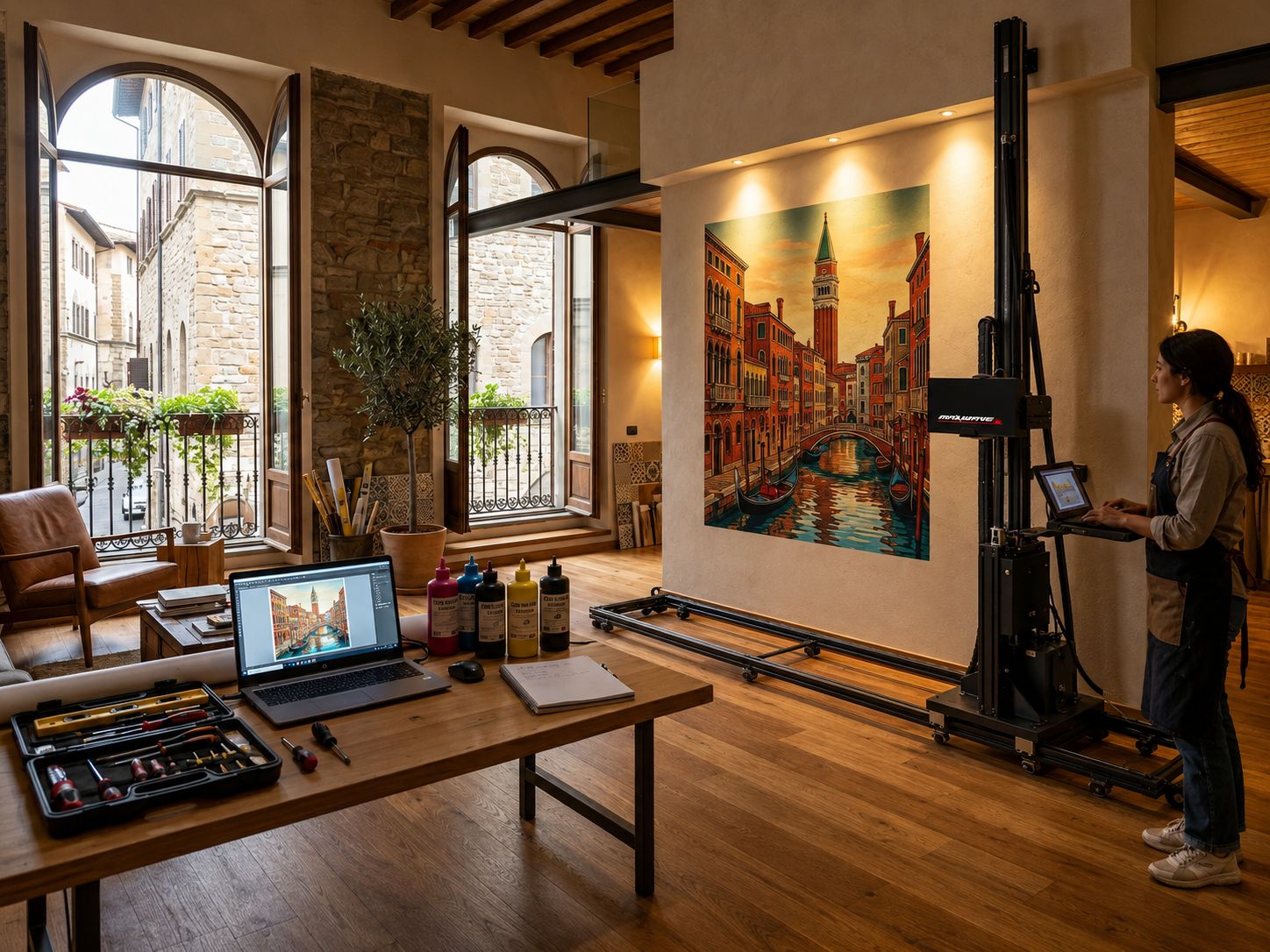
The wall is no longer just a surface — in the right hands, it's a revenue stream.
You now have everything a serious Italian buyer needs to move from curiosity to contract:
Vetted suppliers across three sourcing tiers
A customs clearance roadmap with real HS codes
CE compliance checkpoints that protect your investment
Machine specs matched to actual budget ranges
The smartest next step? Don't start with price. Start with a sample print request. Any supplier worth your €8,000+ should prove their high resolution wall printing quality on your terms. Do this before a single euro moves.
Pick two suppliers from this guide — one European, one China-direct. Run them in parallel. Then compare three things:
Lead times
Certification documents
After-sales support
That 30-day process tells you more than any spec sheet ever will.
Italy's interior design market is growing. The contractors already ordering UV wall inkjet printers are moving now.
Don't wait.
Ready to compare wall printer solutions for the Italian market? Contact us today to request machine specifications, sample print support, and a tailored quotation.